

Upplysning: Det här inlägget kan få ersättning från partners listade genom affiliate-partnerskap, utan kostnad för dig. Detta påverkar inte våra betyg, och åsikterna är våra egna. Läs mer här.
Om du vill ha en djupgående och detaljerad recension av Seeking Alpha har du kommit till rätt plats.
Först får du reda på vad Seeking Alpha är, hur Seeking Alpha kan gynna dig och dina investeringar, och sedan går vi in på mer detaljer, till exempel:
Du kan antingen bli en grundläggande Seeking Alpha-medlem gratis, prenumerera på Seeking Alphas Premium Plan (vilket är vad jag använder), eller så kan du använda Pro Plan.
Är du redo att se om Seeking Alpha är den bästa investeringsforskningsplattformen för dig?
Låt oss dyka in direkt.
Totalbetyg:
Betyg 4,8 av 5
Anpassade verktyg
Högkvalitativt innehåll
Djupgående aktieanalys
Kan vara beroendeframkallande
Komplext gränssnitt
Kan vara överväldigande
Seeking Alpha är en investeringsanalysplattform designad för medelstora till avancerade investerare som vill ha kostnadseffektiv, opartisk och kvantitativ information.
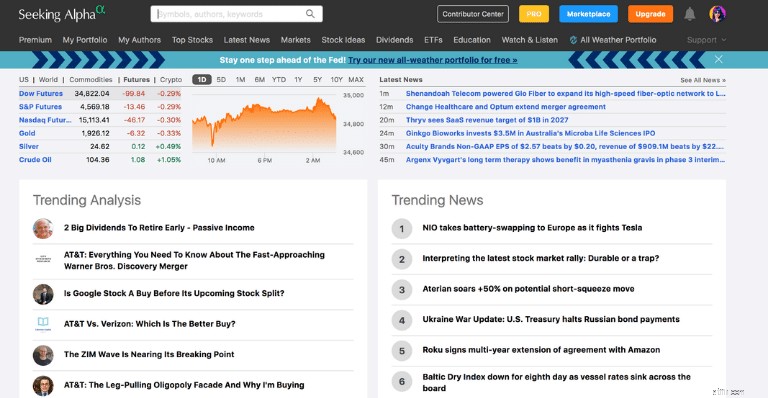
Vissa verktyg kan du börja använda om du registrerar dig för Seeking Alpha , inkludera:
Sedan Seeking Alpha startade 2004 har plattformen lockat över 20 miljoner användare varje månad.
Här är något fint som du kanske inte visste om namnet Seeking Alpha:
Termen "alfa" är inte bara den första bokstaven i det grekiska alfabetet utan den användes också av grekerna för att representera siffran 1.
Termen "alfa" är faktiskt också en finansiell term och uttrycks som följande symbol:
Här är vad termen "alfa" betyder i ekonomiska termer:
Alfa för en portfölj uttrycks vanligtvis som antingen ett positivt tal, ett negativt tal eller en 0.
Så här skulle dessa siffror betyda:
2 %
Portföljen överträffade marknaden med 2 %
0 %
Portföljen utvecklades i linje med marknaden
-2 %
Portföljen underpresterade marknaden med 2 %
Så i verkligheten har Seeking Alpha-plattformen ett mycket smart ordspel med sin titel.
Seeking Alpha representerar vår önskan att bygga en portfölj som kan överträffa marknaden.
Det slutliga målet med Seeking Alpha är att hjälpa fundamentala investerare att dela information och idéer med likasinnade investerare på plattformen.
När du väl har registrerat dig och blivit en Seeking Alpha-medlem får du exklusiv tillgång till artiklar och nyhetsbrev författade av erfarna och legitimerade fundamentala investerare.

Den högsta investeringsrelaterade meriteringen som någon kan tjäna (förutom kanske en doktorsexamen) är CFA-certifieringen.
Även om inte alla författare kanske har en CFA-beteckning - vilket är helt okej - är de som bär CFA-bokstäverna också bra kandidater att lära av.
Även om du använder Seeking Alphas gratisplan kan du fortfarande ha tillgång till:
Ta en titt på bara ett utdrag av de många artiklarna som publiceras dagligen:
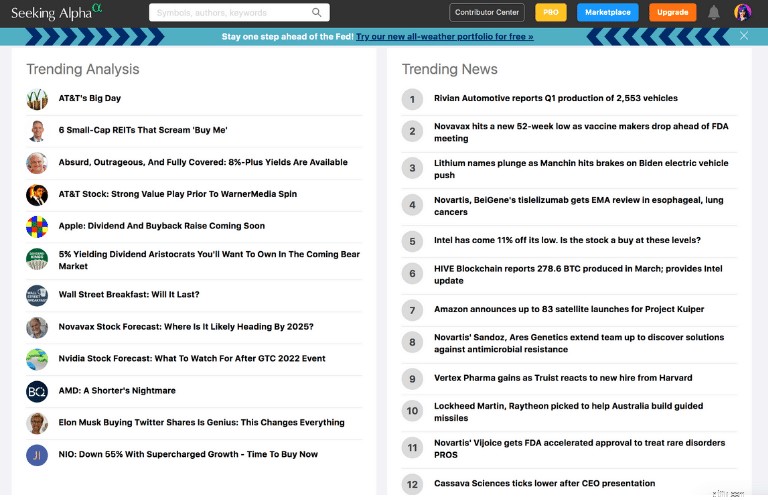
Faktum är att Seeking Alpha har mer än 7 000 aktiva, erfarna författare som publicerar mer än 10 000 djupgående recensioner varje månad.
Dessa författare dyker djupt in i aktier , granskar varje företags ekonomi och ger sin egen åsikt om huruvida aktien ska vara en:
Nu, förutom att lära dig av dina professionella investeringskamrater om varje aktie, ger Seeking Alpha dig också chansen att göra din egen research.
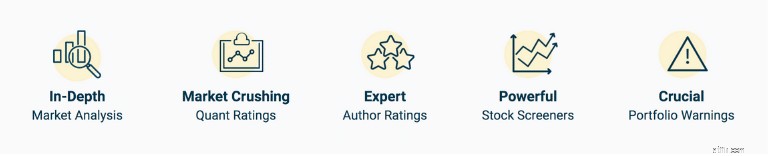
Några snygga forskningsverktyg som är tillgängliga för alla Premium- och Pro-medlemmar inkluderar:
Vi kommer att gå in mer i detalj om dessa verktyg senare i artikeln (så fortsätt läsa!).
Huvudtanken här är att Seeking Alpha ger dig det bästa av två världar:Du kan lära av och interagera med dina kamrater samt få praktisk erfarenhet när det kommer till investeringsanalys.
Låt oss ta en överblick över för- och nackdelarna för Seeking Alpha (för de betalda alternativen):
Minimalt till inga annonser
Dyrt om du är en tillfällig investerare
Tillgång till exklusiva dagliga nyhetsbrev, intervjuer och artiklar
Mindre täckning på krypto jämfört med andra sektorer
Insiktsfull kvantitativ analys av aktier
Är fokuserad på investeringsanalys och automatiserar inte dina egna investeringar
Anpassa lagervarningar (du får push-meddelanden)
Användbarhet/gränssnitt kan vara förvirrande
Crowdsource-artiklar ger dig chansen att interagera direkt med författarna
De flesta artiklar och aktier är främst inriktade på USA (och ibland Kanada)
Du kan anpassa många av Seeking Alpha-verktygen
Kan vara komplicerat om du är en passiv investerare (ingen dagshandel)
Innan du läser vidare, kolla in mina betyg för var och en av följande 6 kategorier:
Investeringsinsikter
⭐️⭐️⭐️⭐️⭐️
Investeringsverktyg
⭐️⭐️⭐️⭐️⭐️
Kundtjänst
⭐️⭐️⭐️⭐️⭐️
Användbarhet
⭐️⭐️⭐️⭐️⭐️
Kostnad
⭐️⭐️⭐️⭐️
För att ge lite mer detaljer om orsaken till mina betyg, ta en titt på min uppdelning nedan:
Hittills är jag ganska imponerad av Seeking Alpha.
Seeking Alpha grundades 2004 av David Jackson.
David arbetade som aktie- och teknikanalytiker på Morgan Stanley under teknikbubblan, undersökte aktier och skrev upp sina resultat.
Det var under denna tid som David insåg att det fanns en inneboende intressekonflikt om stora investeringsbanker publicerade sin forskning om vissa investeringsprodukter, särskilt om storbankerna sålde dessa investeringsprodukter.
Varför skulle en stor investeringsbank publicera en forskningsartikel om en underordnad produkt som banken själv säljer?
Det var så Seeking Alpha föddes.
Här är några fler detaljer du bör veta om Seeking Alpha:
År grundat
2004
Huvudkontorsplats
Ra’anana, Israel
Månatliga användare
20 miljoner+
Månatliga tittare
40 miljoner+
Aktiva författare varje månad
7 000+
Månatliga publicerade artiklar
10 000+
Månadskostnad
– Begränsad åtkomst =$0
– Premium =19,99 USD
– Pro =199,99 USD
Vem ska använda Seeking Alpha
– Mellanliggande investerare
– Avancerade investerare
– Daghandlare
Innehållstyp
– E-post
– Podcasts
– Videoinnehåll
– Skriftligt innehåll
Utmärkande funktioner
– Bokslut
– Avskrifter av inkomstsamtal
– Anpassade lageraviseringar
– Fördjupad analys från experter
– Transparent aktievärderingssystem
– Jämförelsediagram för aktieprestanda
Tillgänglighet
– iPad
– Desktop
– Android
– iPod touch
– iPhone (iOS 12.2 eller senare)
Kundtjänst
– E-post
– Telefon
– Forum
Kundtjänst öppettider
Måndag till fredag 8.00 till 16.00 EST
Landstillgänglighet
Internationellt
Även om Seeking Alpha är tillgängligt för en internationell publik, bör jag notera att plattformens huvudsakliga investeringsforskningsfokus ligger på USA och Kanada.
Jag är ett stort fan av webbplatsens gränssnitt för Seeking Alpha.
Personligen tycker jag att Seeking Alpha är väldigt användarvänligt, inuitivt och det gör också ett bra jobb med att visa informationen på ett organiserat sätt.
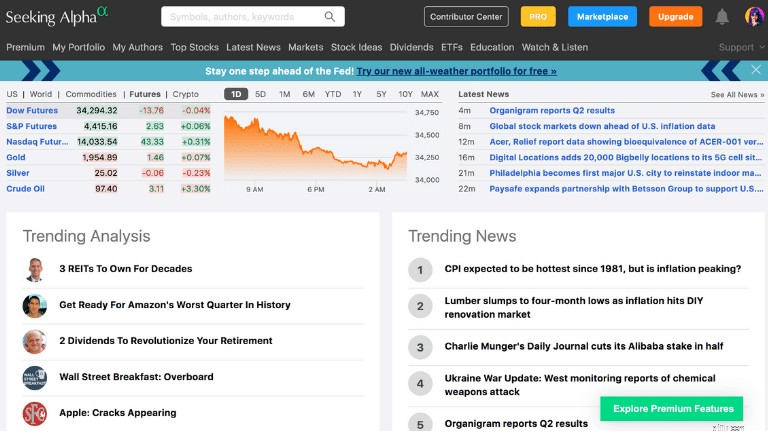
Nu är den enda konstruktiva feedback jag skulle ha att för nybörjarinvesterare – och även för medelanvändare – kanske informationen om Seeking Alpha inte alltid hittas intuitivt.
Till exempel, om du letar efter de främsta ETF:erna på tillväxtmarknaderna, skulle du förmodligen inte veta var du ska leta.
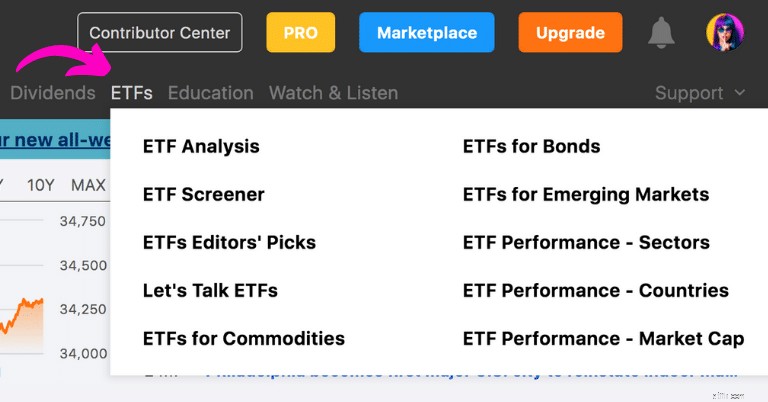
Den enda logiska platsen där jag skulle leta efter ETF:er på tillväxtmarknader skulle vara under ETF-fliken – men det finns fortfarande ingen ytterligare information om ETF:er på tillväxtmarknader.
I verkligheten, för att hitta de bästa ETF:erna på tillväxtmarknaderna, måste du klicka på "ETF Screener" och "ETF Performance - Sector."
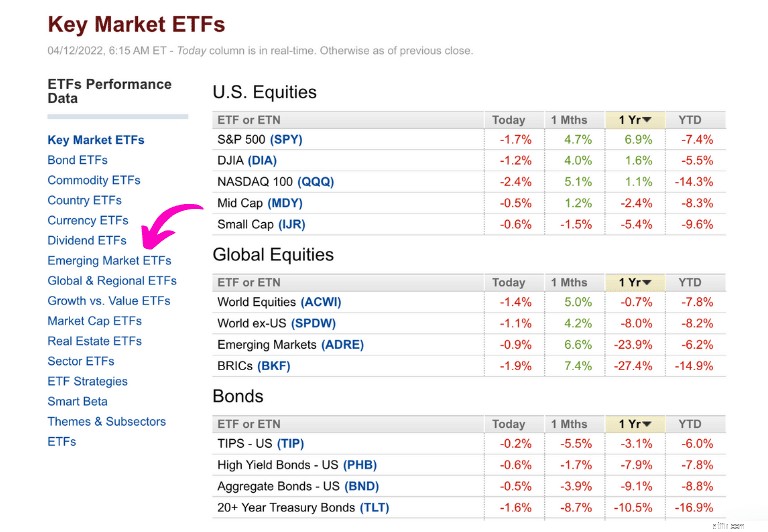
Därifrån måste du klicka på det vänstra verktygsfältet för att faktiskt sortera efter ETF-kategorin (i det här fallet, tillväxtmarknader) som du letar efter.
Sammantaget har Seeking Alpha byggt en fantastisk grundforskningsplattform för varje investerare.
Du kommer förmodligen bara ha en liten inlärningskurva innan du blir helt bekant med plattformen och hur den fungerar.
Seeking Alpha har 3 planer, varav 2 är betalversioner:
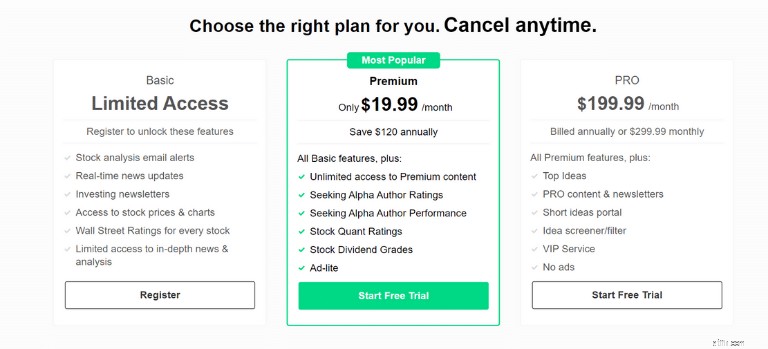
Jag använder Premium-planen och jag är mycket nöjd med dess funktionalitet och dess funktioner.
Det här är vad du kan förvänta dig när du öppnar ett konto hos Seeking Alpha:
Minsta kostnad
$0 [begränsad åtkomstplan]
Maximal kostnad
199,99 USD/månad [Pro Plan]
Betalningsmetoder
– PayPal
– Kreditkort
Tänk på att dina Premium- (eller Pro-planer) kommer att faktureras årligen för att täcka månadskostnaderna för $19,99 (Premium) eller $199,99 (Pro).
Annars skulle du betala 29,99 USD/månad (Premium) och 299,99 USD/månad (Pro).
Här är en kort översikt över vad du får med varje Seeking Alpha-prenumeration:
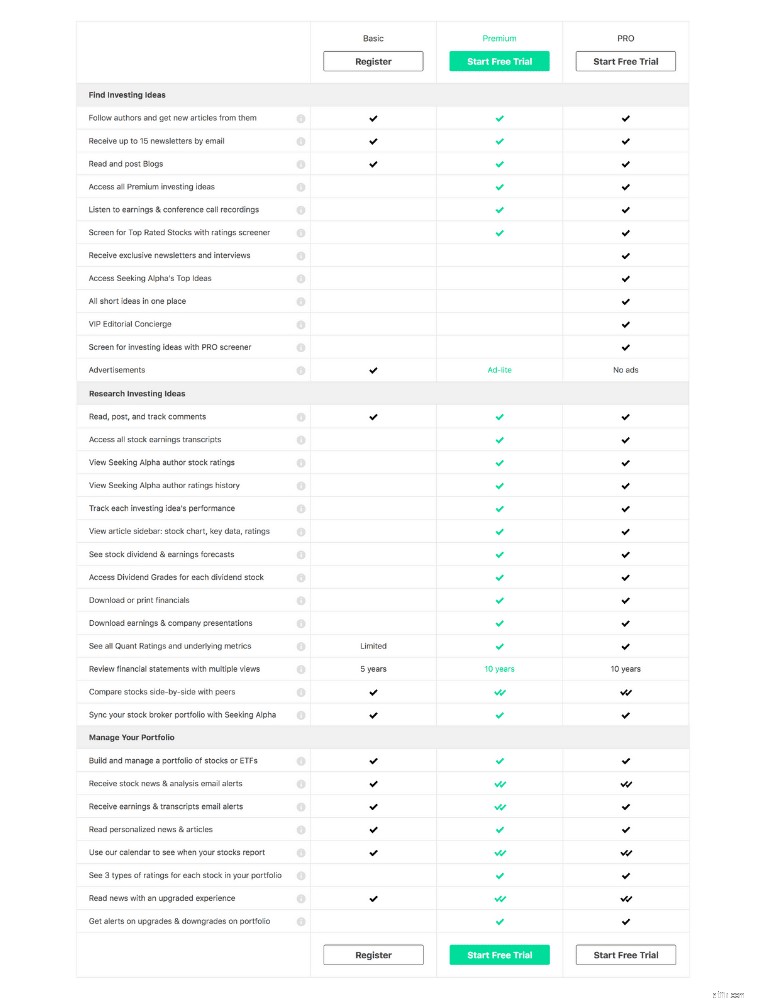
Den goda nyheten är att du kan starta en gratis 14 dagars provperiod med Premium-planen och till och med Pro-planer.
Normalt sett bör du få en påminnelse via e-post några dagar innan testperioden slutar, men jag har läst flera klagomål om att kreditkorten debiterades precis när provperioden tog slut.
Fortsätt att läsa följande avsnitt, för jag kommer att förklara mer detaljerat om varje tjänst och vad du får för pengarna.
Huruvida en Seeking Alpha-plan är värd kostnaden beror verkligen på dig och dina mål.
Nedan har jag delat upp en enkel graf för att visa vilken plan som troligen skulle vara bäst om du:
Läs artiklar dagligen
✔️
✔️
Interagera med författare
✔️
✔️
E-postvarningar
✔️
✔️
Inga annonser
✔️
Njut av Analytics
✔️
✔️
Vill ha VIP-service
✔️
Vill ha exklusivt innehåll
✔️
Är en Day Trader
✔️
✔️
Pengar är inget bekymmer
✔️
Personligen tror jag att Premium-planen är perfekt för alla som är en normal person och vill:
Såvida du inte verkligen är en dagshandlare eller driver ditt eget litet företag och behöver den extra exklusiva touchen, skulle jag säga att premiumplanen förmodligen är det bästa värdet, med tanke på vad du spenderar.
Det är nästan omöjligt att slå marknaden konsekvent, men Seeking Alpha ger dig verkligen fördelen att överträffa marknaden.
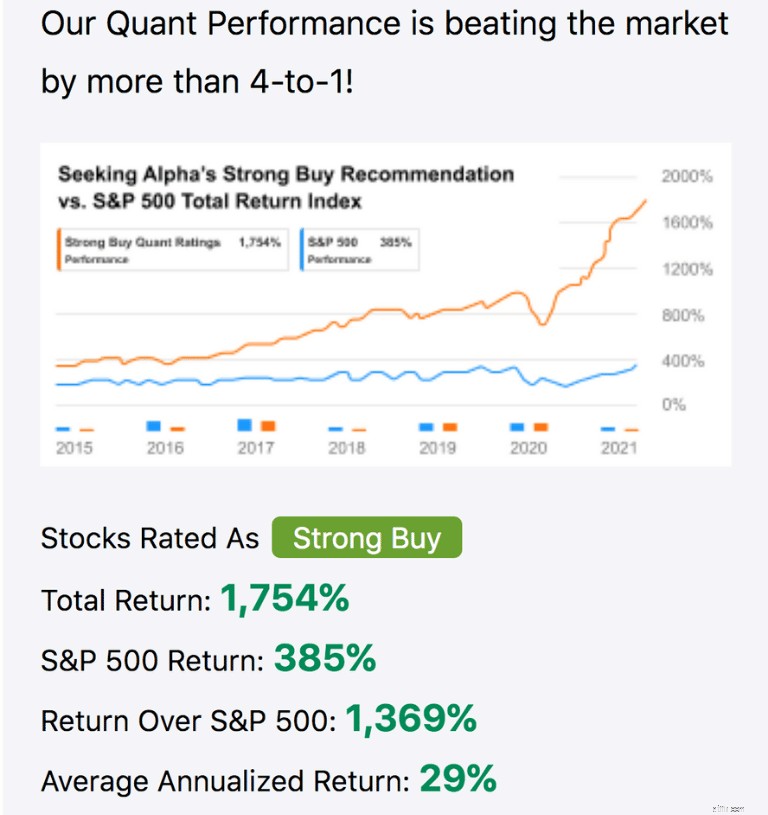
Sedan 2010 har Seeking Alphas kvantitativa algoritm överträffat S&P 500 avsevärt och slagit den 9 av 10 gånger.
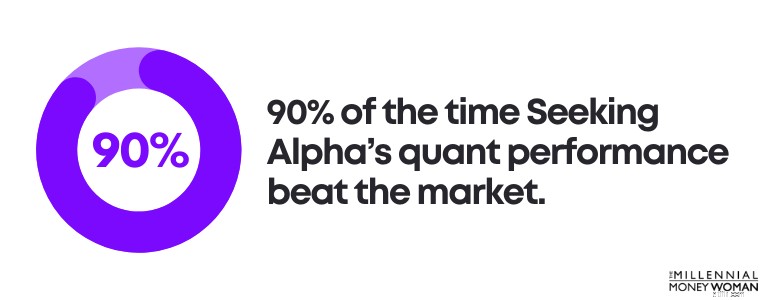
De "Very Bullish"-aktierna gav en avkastning på 1 754 % medan S&P 500 endast gav en avkastning på 385 %.
Så hur får du tillgång till ett verktyg som dramatiskt ökar dina odds att överträffa marknaden?
Genom att registrera dig för Seeking Alpha Premium Package .
Tänk på det så här:
Tänk bara på att tidigare resultat inte nödvändigtvis indikerar framtida resultat.
Om du inte är redo att spendera pengar på Seeking Alpha och bara vill registrera dig för den kostnadsfria planen, kolla in det här avsnittet, tillägnat den begränsade åtkomstplanen:
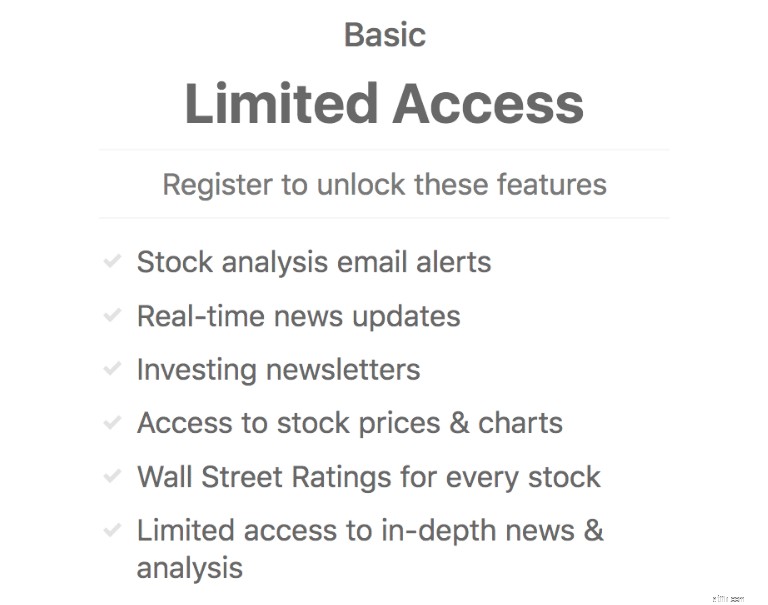
Med planen med begränsad åtkomst kan du bland annat göra följande:
Några nackdelar med planen med begränsad åtkomst inkluderar:
Om du känner dig intresserad och vill ha mer, överväg att prenumerera på en av Seeking Alphas betalplaner (Premium eller Pro).
Det fina med Seeking Alpha Premium (och Pro)-planen är att du kan starta en gratis 14-dagars provperiod för att testa planen innan du förbinder dig ekonomiskt.
Du kan avbryta din provperiod när som helst för att säkerställa att du inte debiteras hela beloppet (vilket Seeking Alpha kan göra om du inte avbryter innan provperioden är slut).
Om du njöt av provperioden för Premium-planen kan du betala för Premium-planen på tre sätt:
Månadsplan
29,99 USD/månad
Årsplan
239 USD (eller 19,99 USD/månad, enligt annonsering)
3-års plan
540 USD (eller 14,99 USD/månad)
Det verkar som att standardfallet för Seeking Alpha debiterar hela årets premier i förskott (alltså $239 för premiumplanen).
En av de största fördelarna med att registrera dig för Premium-planen framför Limited Access-planen är att du får exklusiv tillgång till investerargemenskapen, så att du kan:
Jag är en Premium Plan användare och det jag gillar mest är att du bokstavligen kan brainstorma idéer med dina kamrater om din nästa investering.
I det här avsnittet kommer jag att förklara i detalj några av mina favoritfunktioner i Premium Plan och hur du kan dra nytta av var och en.
Här är en översikt över Seking Alpha Premium-funktionerna:
Om du vill veta mer om dessa funktioner, fortsätt läsa.
Till skillnad från planen med begränsad åtkomst, som kan ha många annonser, erbjuder premiumplanen en "ad-lite" användarupplevelse.
Som ett exempel kan du få några bannerannonser under hela din surfning, till exempel följande:
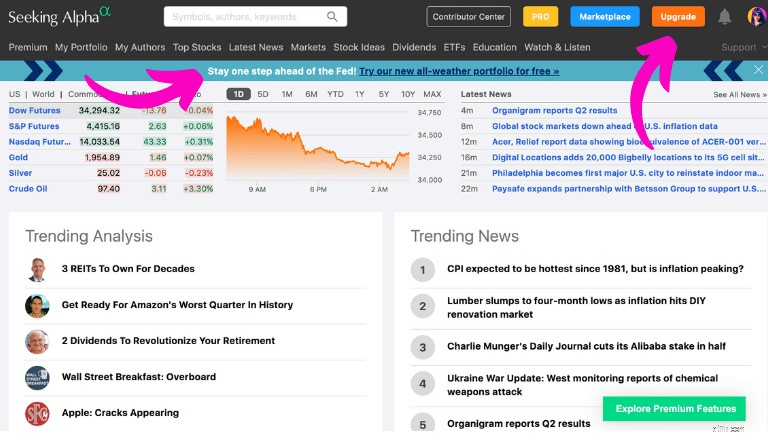
Som du kan se med min Premium-prenumeration marknadsför Seeking Alpha några av sina produkter (i det här fallet Pro-paketet).
För att vara ärlig stör jag mig inte på de här annonserna och tror inte att de tar bort min erfarenhet.
Undrar du om en aktie är övervärderad eller undervärderad?
Kolla in Wall Street-betygen för den aktien och rulla till avsnittet "Prismål".
I det här fallet använde jag Google som ett exempel, så låt oss ta en titt på Googles prismål (och från och med april 2022 handlades Google för 2 595,93 USD).
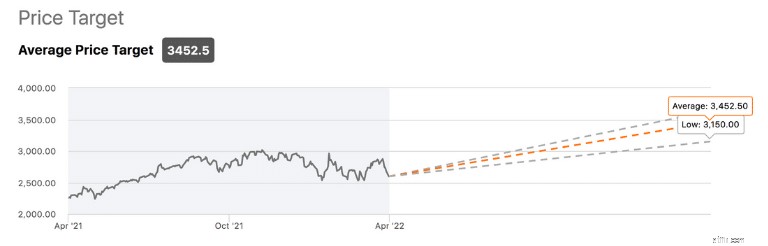
Med andra ord, baserat på kursmålet (3 452,50 USD) kontra den faktiska kostnaden för aktien (2 595,93 USD), är Google-aktien faktiskt undervärderad.
Det är förmodligen därför 98 % av analytikerna i Wall Street Ratings-avdelningen värderar Google antingen som ett "Köp" eller ett "starkt köp".
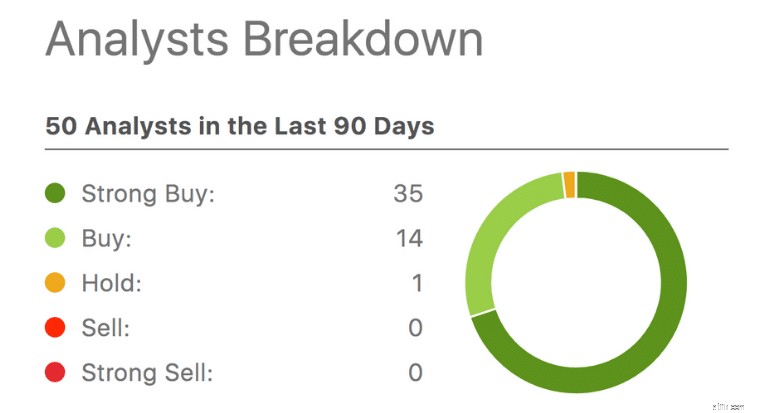
Grafen nedan är ett annat snyggt exempel på prismålsfunktioner.
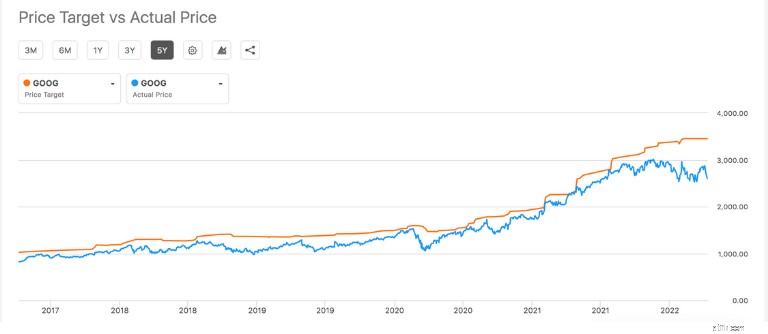
I diagrammet Prismål vs faktisk pris ser du att prismålet (i rött) nästan alltid har varit lite högre än Googles faktiska pris (i blått).
Så om du är en värdeinvesterare Om du vill köpa aktier som för närvarande är undervärderade kanske du vill överväga Google som en investering.
Nu kanske du också kommer ihåg GameStop ($GME) fiaskot i början av 2021, när handlare på Reddit samlade pengar i den misslyckade $GME-aktien, vilket orsakade några stora finansiella hinder för hedgefonder och investeringsplattformar som Robinhood.
Ja, vissa människor kan ha tjänat pengar i den här kortlivade sagan, men de har förmodligen förlorat pengar.
Ta en titt på kursmålsgrafen nedan, som skulle ha visat alla rationella investerare att det var ett riskabelt drag att plöja pengar i $GME:
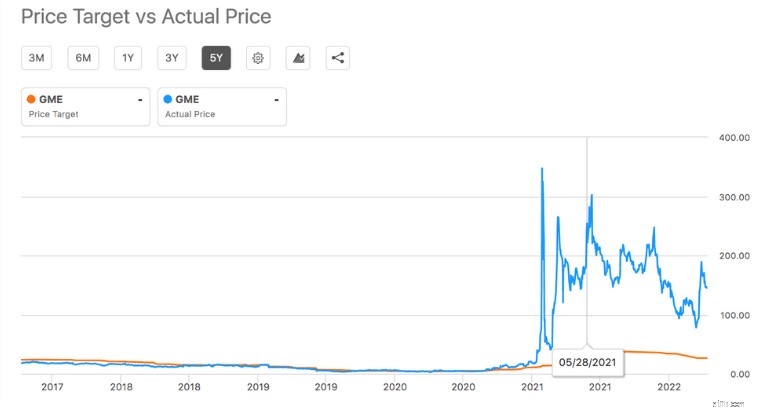
Som du kan se har kursmålet (i rött) konsekvent svävat runt några få dollar medan det faktiska priset på GME USD steg upp till över 300 USD vid ett tillfälle.
Kom ihåg att fokusering på bara en datapunkt, som kursmålet, inte bör vara den avgörande faktorn för om du köper eller säljer en aktie. Ett prismål är helt enkelt en vägledning som bör övervägas i samband med annan information.
Om du är en medelinvesterare som vill brainstorma nya investeringsidéer, kanske du vill prenumerera på Seeking Alpha's Notable Calls.
Du kan prenumerera på Notable Calls och få syntetiserade och sammanfattade idéer från företag över hela världen.
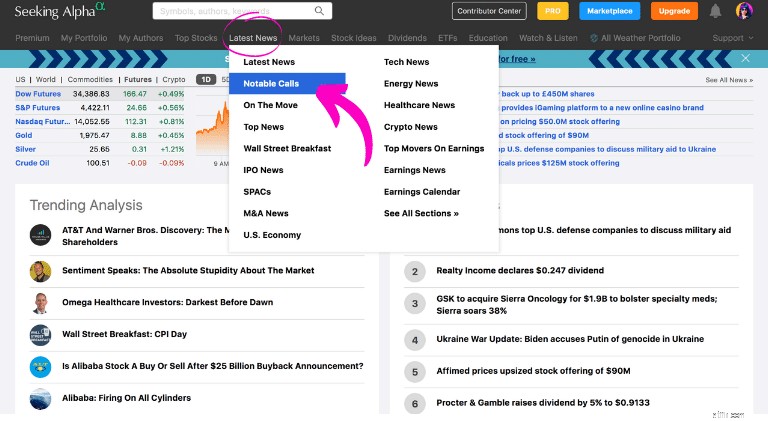
Du kan läsa avsnittet Notable Calls genom att klicka på "Senaste nyheterna" och sedan klicka på "Notable Calls."
När du väl är i avsnittet Notable Calls kan du utforska olika ämnen (allt från fiberoptik till klädmärken som Levi Strauss).
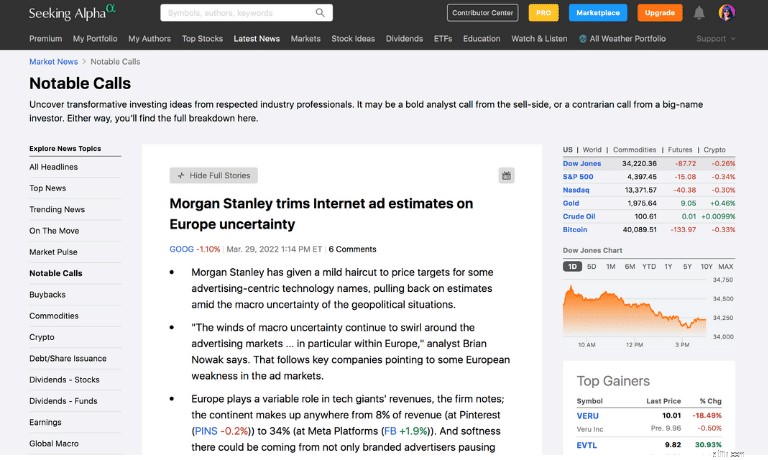
Notable Calls publiceras inte dagligen – ibland kan det till och med ta en månad innan ny information fylls i avsnittet Notable Calls.
Eftersom Notable Calls-artiklarna inte publiceras konsekvent, se till att fortsätta läsa bidragsartiklarna från Seeking Alpha-expertförfattarna för att samla fler investeringsidéer.
Eftersom Seeking Alpha är en crowdsourcing-plattform kommer det inte som någon överraskning att varje aktie också kommer med ett Seeking Alpha-författarbetyg.
Om du till exempel tittar på sammanfattningssidan för AT&T Inc., ser du betygen för $T-aktien uppdelade efter kategori:
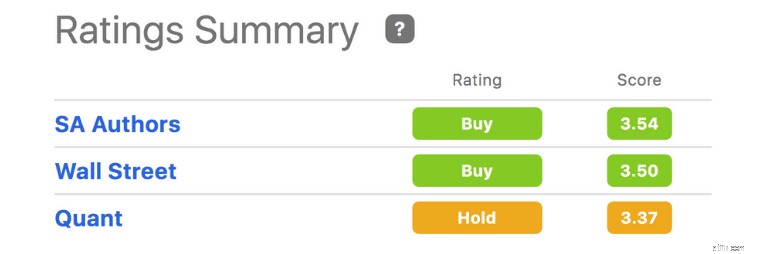
För att lära dig mer om Sökande Alpha-författarbetyg, klicka på den blå hyperlänken "SA Authors".
Här ser du Seking Alpha Author Ratings för en aktie som:
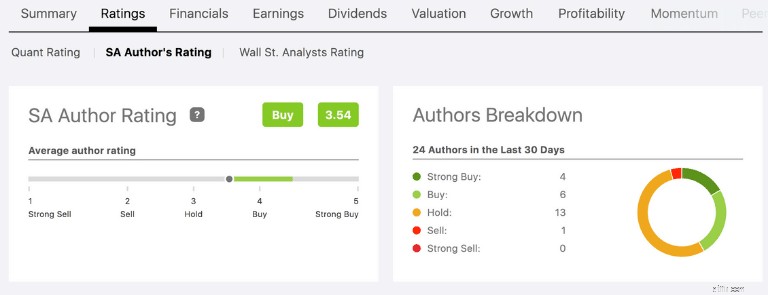
Du kommer bland annat att se betyget Seeking Alpha Author Rating och Authors Breakdown för varje betyg.
I AT&T:s fall rekommenderade 10 av 24 författare att köpa eller starkt köpa aktien (cirka 42%).
Dessutom kan du också granska författarbetygens meritlista för de senaste åren:
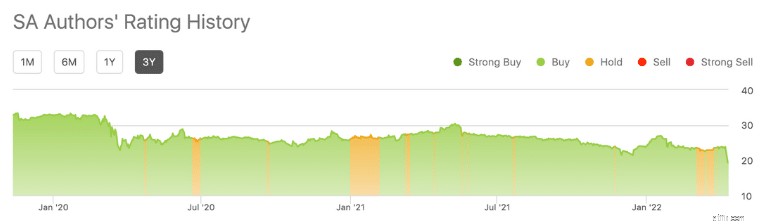
Baserat på det här diagrammet har författarna av Seeking Alpha generellt rekommenderat "Köp" eller "Köp starkt" AT&T under de senaste 3 åren.
Det är nyligen som författarna har föreslagit att "hålla" istället för att köpa.
Slutligen kan du också välja att visa betygshistoriken efter författare:
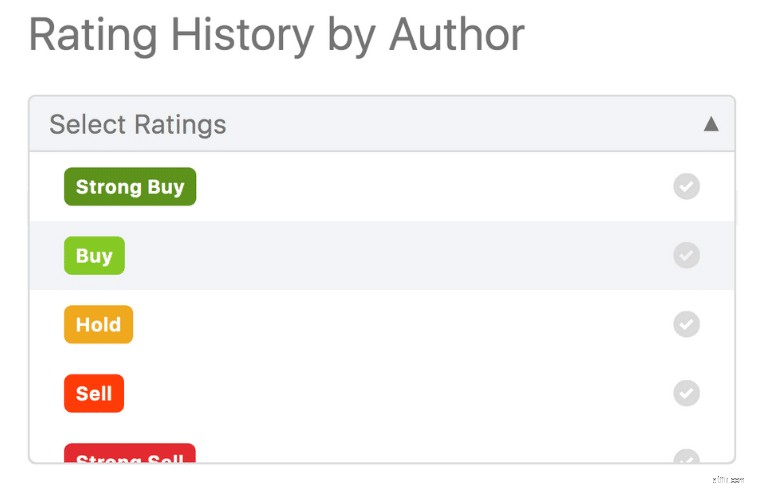
Så om du är nyfiken på att se vilka författare som betygsatt AT&T som ett "Köp" kontra ett "sälj"-förslag, till exempel, är det här platsen att göra det.
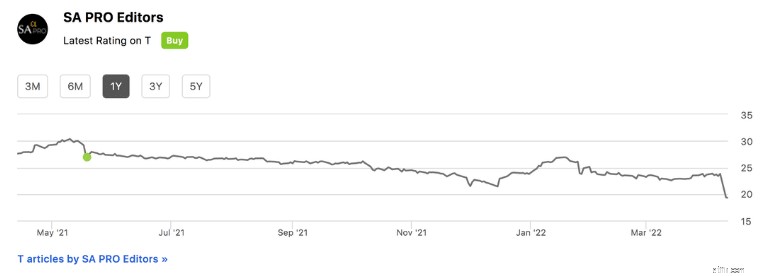
Ovan är en skärmdump av en författare som rekommenderade att köpa AT&T-aktier.
Om du undrar varför författaren rekommenderade att göra det, kan du klicka på den blå hyperlänken för att läsa om författarens AT&T-artiklar.
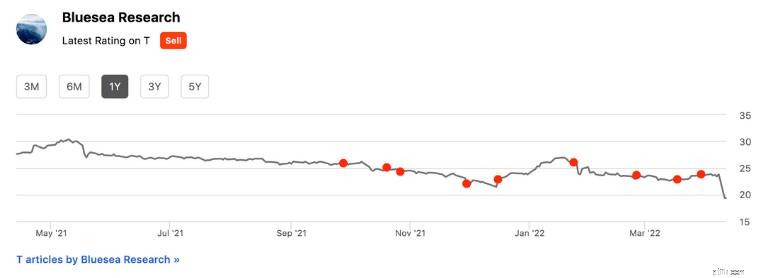
På samma sätt, om du hittar en författare som har föreslagit att sälja $T-aktien, kan du ta reda på när författaren föreslog att göra det (se de röda prickarna på grafen i förhållande till $T-aktiens resultat).
Återigen, du kan läsa artiklar av den författaren på AT&T genom att klicka på den blå hyperlänken under författarens försäljningsdiagram.
Om du är en utdelningsinvesterare , det här är en av de häftigaste funktionerna du hittar:The Dividend Grade Tool.
Kort sagt är verktyget Dividend Grade utformat för att hjälpa investerare att avgöra om en utdelning är säker och om utdelningsintäkterna kommer att vara stabila, öka eller möjligen minska.
Det finns 4 olika utdelningsgrader, som förklaras nedan:
Utdelningssäkerhet
Mäter en utdelnings lönsamhet och stabilitet
Utdelningstillväxt
Mäter en utdelnings tillväxtpotential genom att använda historiska och uppskattade tillväxttakt (inkluderar intäkter, kassaflöde, vinster, etc.)
Dividendavkastning
Mäter en utdelnings historiska avkastning och jämför avkastningen med andra aktier i samma bransch för att bestämma utdelningens framtida avkastning
Utdelningskonsistens
Mäter konsekvensen av ett företags utdelningsbetalningar och utdelningshöjningar
En anledning till att investerare, särskilt passiva investerare, gillar utdelningar så mycket är att utdelningar är en form av passiv inkomst .
Och ju mer utdelningsbetalande aktier du köper, med tiden kan du verkligen börja tjäna lite pengar bara genom utdelningsbetalande aktier.
Ta en titt på AT&Ts nuvarande utdelningsbetyg (från april 2022):
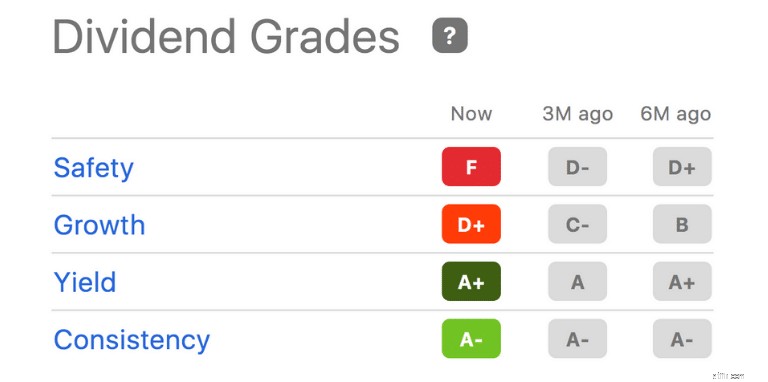
Det jag gillar med Dividend-betygen är att du kan se de nuvarande betygen jämfört med de för 3 månader sedan och till och med 6 månader sedan.
Det är uppenbart att utdelningssäkerheten för AT&T är i fara. Detta innebär att AT&T kan minska eller till och med eliminera sin utdelning.
Och det är sant – ta en titt på den röda varningsbannern när jag skriver $T i sökfältet:
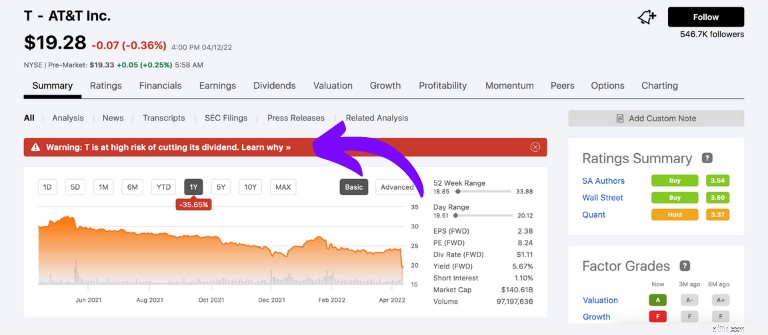
Utan att ens titta på utdelningsbetygen får jag omedelbart besked om att AT&T kan sänka sin utdelning.
Om du vill lära dig mer om det klickar du bara på bannern:
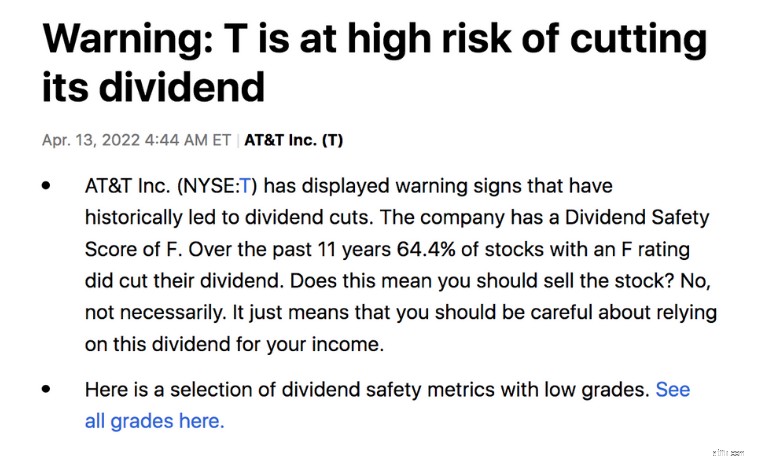
Du kommer att omdirigeras till en artikel med en ytterligare analys av varför AT&T kan minska sina utdelningar inom en snar framtid.
Om du nu vill fördjupa dig i de individuella utdelningsbetygen klickar du bara på den blå hyperlänken för varje utdelningsbetyg:
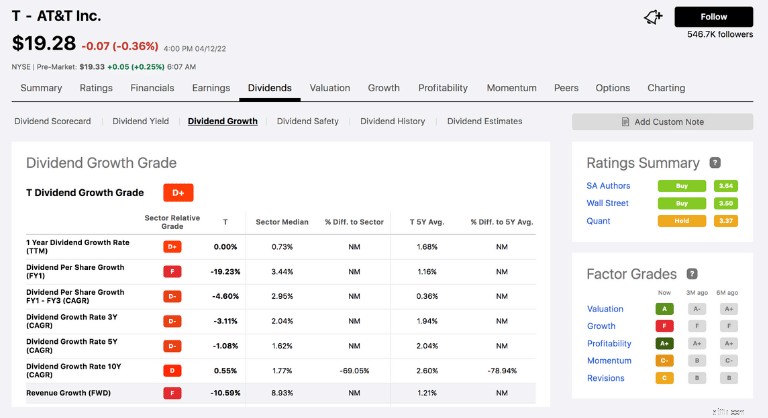
Till exempel, i skärmdumpen ovan, ser du ett utdrag av hur djupgående du blir bara genom att läsa om utdelningstillväxten.
Jag föredrar att kolla in fliken Dividend History, som ser ut så här:
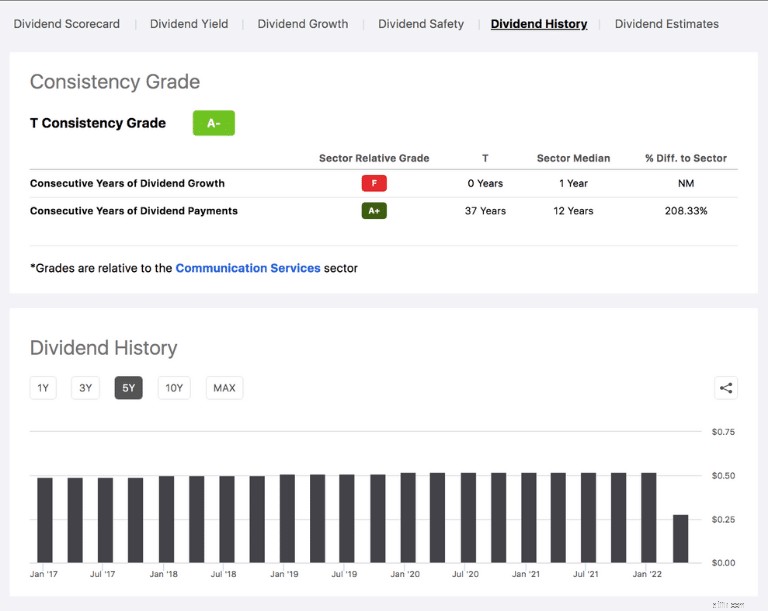
Som du kan se har AT&T under de senaste 5 åren haft en mycket konsekvent utdelningshistorik – men den 12 april 2022 sjönk utdelningen från 0,52 USD till 0,28 USD.
Det är en mycket drastisk nedskärning och signalerar vanligtvis en oro för investerare.
Slutligen, om du vill lära dig mer om framtida utdelningsuppskattningar (som inte är en del av de ursprungliga fyra utdelningsbetygen), kan du klicka på motsvarande flik:
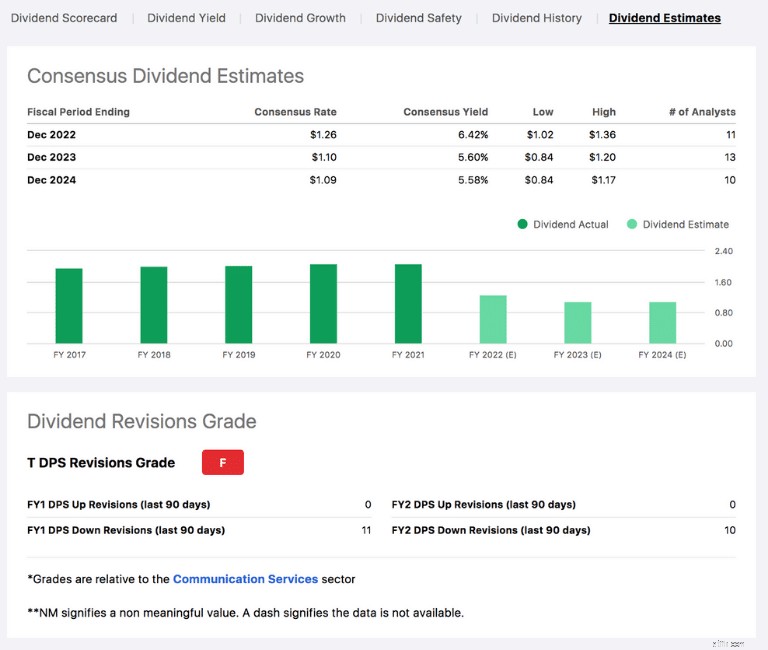
Som du kan se förutspår inte skattningarna av utdelningstillväxten att direktavkastningen kommer att studsa tillbaka till AT&T:s ursprungliga nivåer, åtminstone inte under de närmaste åren.
Om du är någon som bara vill läsa om de viktigaste och mest angelägna aktienyheterna utan att gå in på det knasiga, använd då nyhetsöversikten.
Du kan komma till nyhetsöversikten genom att klicka på fliken "Senaste nyheter".
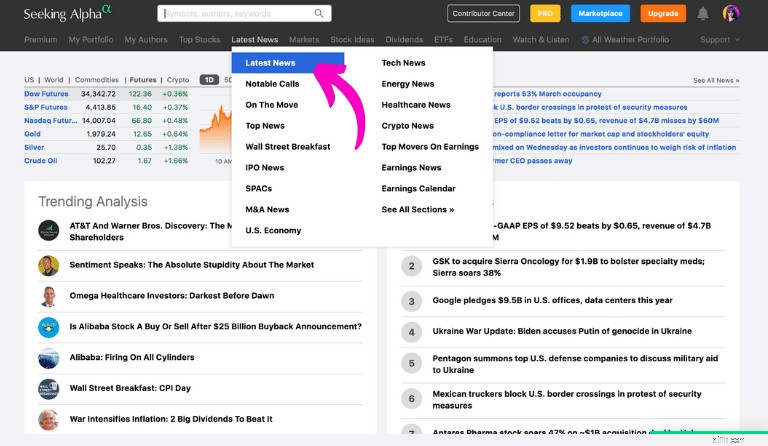
När du har klickat på flikarna "Senaste nyheterna" omdirigeras du till en sida med titeln "Marknadsnyheter."
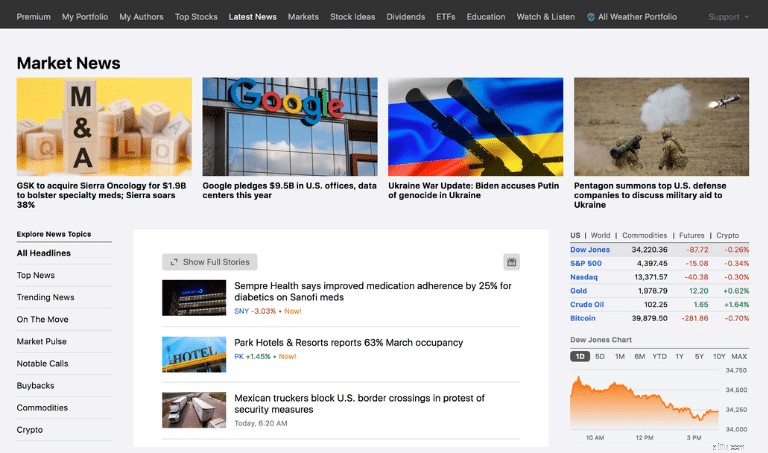
Från den här instrumentpanelen kan du använda filtret (till vänster) för att utforska ämnen som är relevanta för dig.
Du kan till och med ställa in ett datumintervall för att fokusera dina avläsningar på en viss tidsram.
I likhet med utdelningsbetygen kan du också se vad Seeking Alpha kallar ett Factor Scorecard.
Styrkortet är med andra ord ett verktyg som hjälper dig att fatta snabba beslut om du ska överväga en aktie eller utesluta den, baserat på dina investeringskriterier.
Faktorresultatkortet använder 5 faktorer, inklusive:
Låt oss ta en titt på Factor Scorecard för $GME, mer känd som Gamestop.
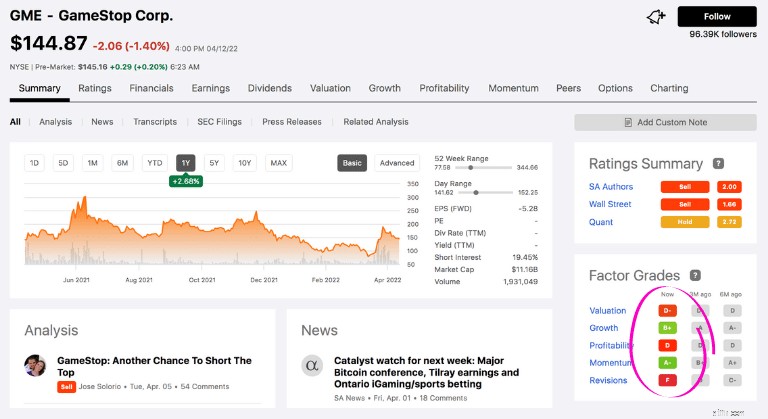
Rutan Factor Grades är uppdelad i de 5 kategorier som jag nämnde tidigare.
Varje kategoris betyg jämförs också med dess tidigare betyg för 3 och 6 månader sedan:
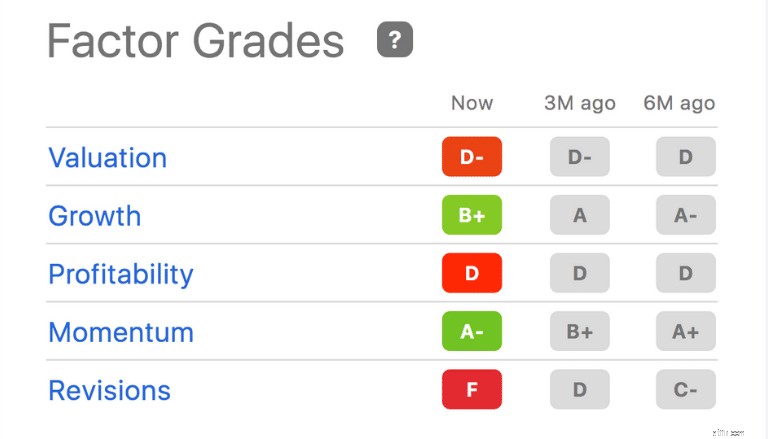
Uppenbarligen är faktorbetygen för Gamestop ganska undermåliga. Det betyder att Gamestop förmodligen inte är den bästa investeringen – om du inte är bekväm med att ta en risk med en ganska volatil aktie.
Om du vill fördjupa dig i de individuella faktorbetygen klickar du bara på den blå hyperlänken för varje betyg.
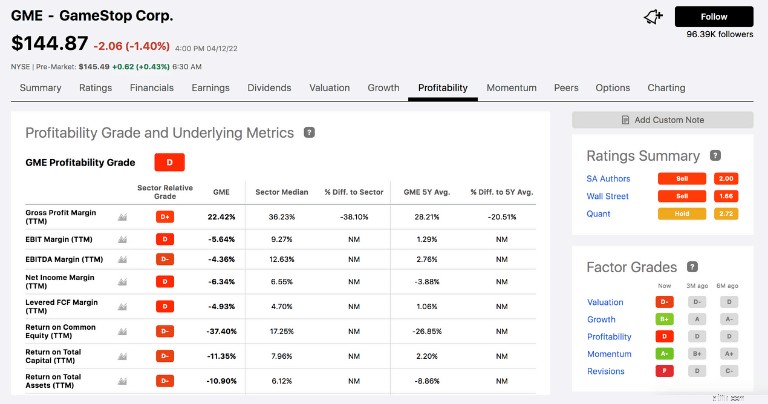
Till exempel, i skärmdumpen ovan, ser du ett utdrag av hur djupgående du blir bara genom att läsa om Lönsamheten hos Gamestop.
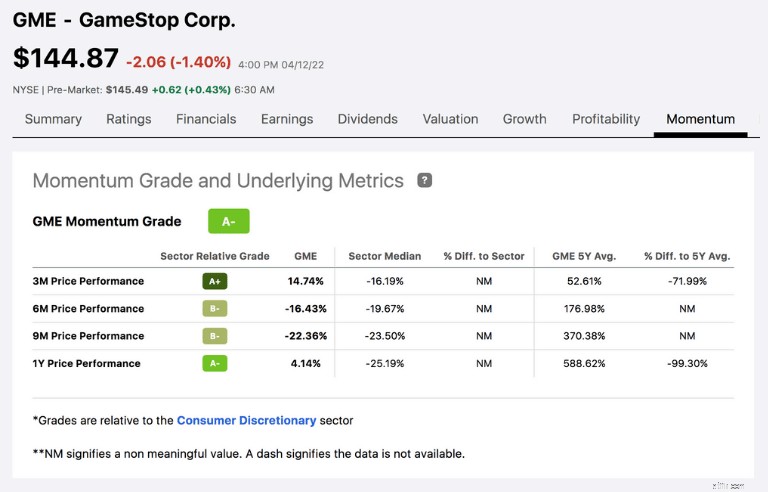
Jag gillar också att titta på Momentum-fliken för att kolla in tidigare resultat och prestanda för $GME jämfört med andra benchmarks – som S&P 500, till exempel.
Här är en ögonblicksbild av Gamestops tidigare resultat i förhållande till andra företag i sektorn:
Du kan också kolla in prisutvecklingen för Gamestop i förhållande till vissa riktmärken.
I skärmdumpen nedan används S&P 500 som riktmärke:
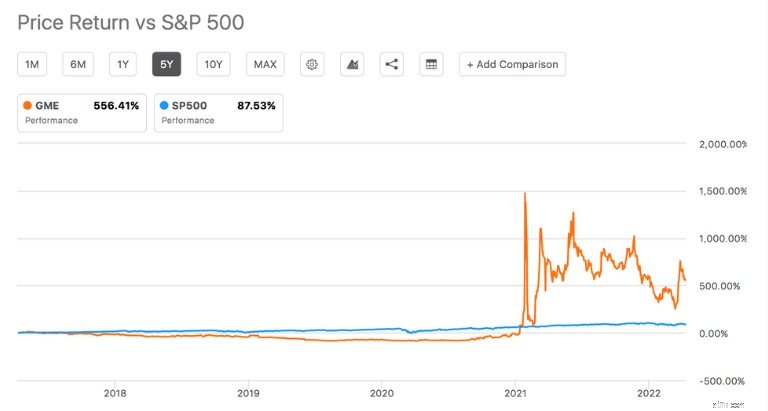
Detta prisreturdiagram berättar hela historien:
Du kan se hur Gamestop konsekvent underpresterade, jämfört med S&P 500 tills Gamestop-sagan började i början av 2021.
Sedan början av 2021 har Gamestop-priserna relativt sett överträffat S&P 500 – men är det verkligen en solid investering?
That’s where Seeking Alpha’s tools like the Factor Scorecard can really come into play and help guide you to an answer.
Let’s say you’re thinking about buying Tesla, but you’re not 100% convinced that it’s the right addition to your portfolio.
That’s where the Peer Comparisons come in.
The Peer Comparison tool is customizable, so you can change the stock types that you’re comparing.
Here’s an example:First, search your desired stock (in this case, Tesla):
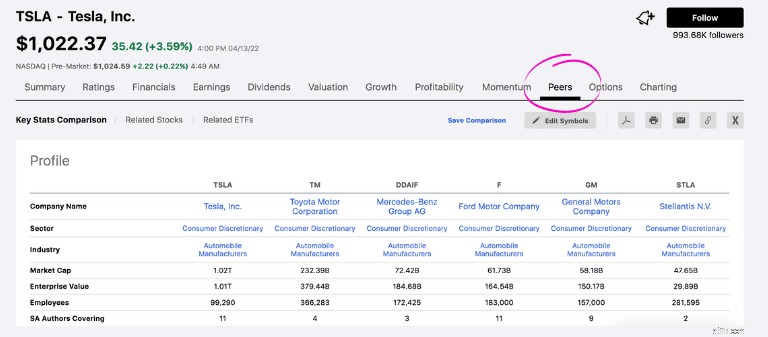
Make sure you click on the “Peers” tab.
Once you’re on the “Peers” tab, you can see that Seeking Alpha already defaults to several peer stocks with which you can compare Tesla.
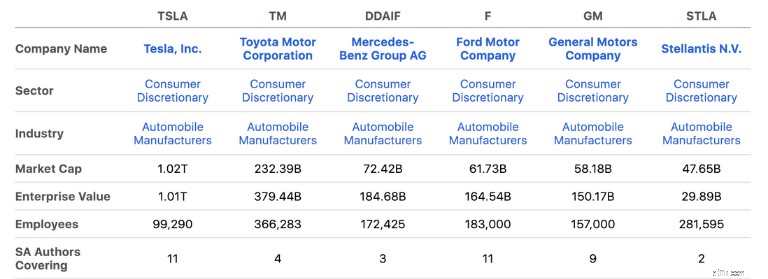
However, if you want to customize the peer comparisons or even reduce the number of peers you’re comparing to, then just click on the “Edit Symbols” button.
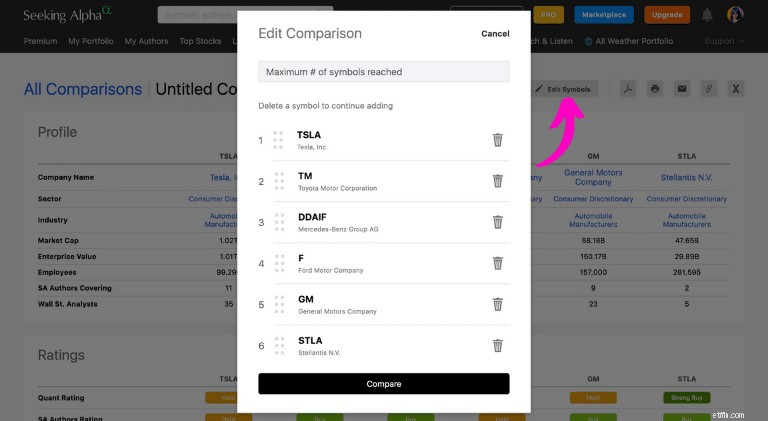
This is where you can customize all peer comparisons.
If you really like a stock and want to receive alerts whenever news about that stock is released, you can customize your own email alerts.
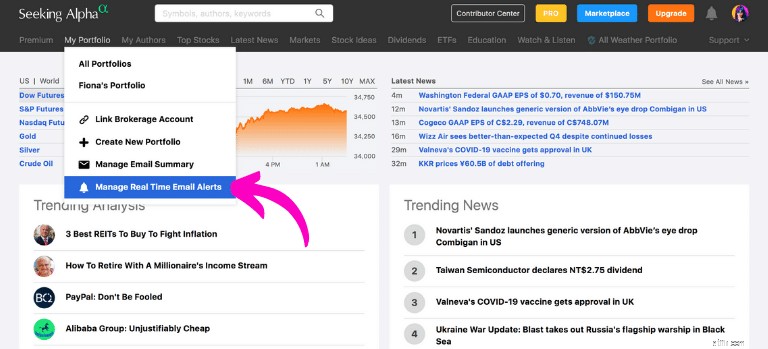
You do this by hovering over the “My Portfolio” tab and then clicking on “Manage Real Time Email Alerts.”
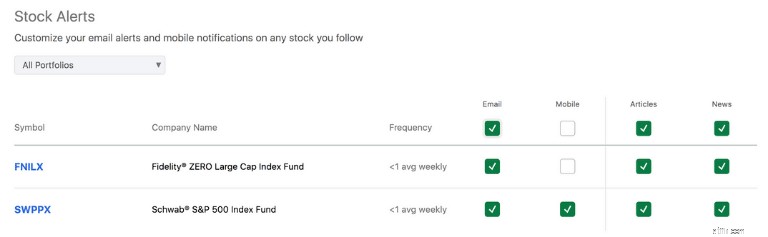
You’ll see a snapshot of your favorite stocks, which you can then select to follow.
The next thing you need to do, is:
I’m a big fan of this alert customization option.
One of the key features when evaluating a stock on Seeking Alpha should be the Quant Ratings section.
Quant Ratings are based on a computer algorithm with the goal to find the best stocks.
As with the previous Ratings (Wall Street and SA Authors), the Quant Ratings compare the stock to other stocks in the same industry.
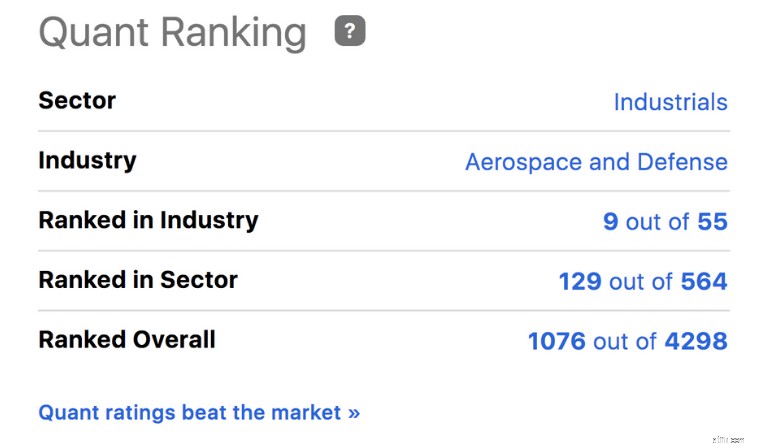
The Quant Rankings use historical information to determine the numbers, as shown in the above screenshot (this case, for Lockheed Martin).
If the Quant Rankings deem a stock to be a top pick, then that stock would be marked as “Strong Buy.”
In Lockheed Martin’s case, the Quant Rankings determined the stock to be a “Hold” for now.
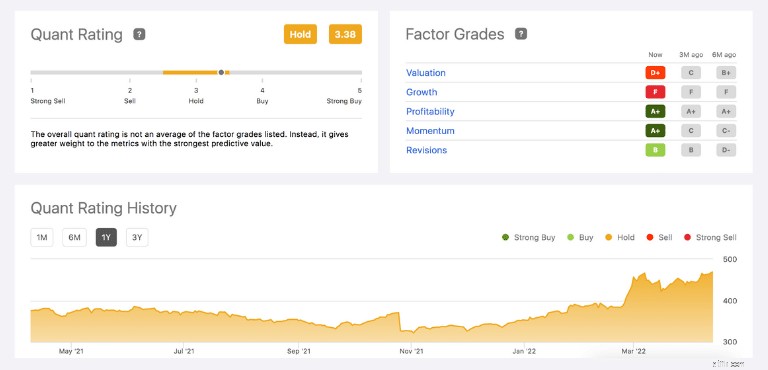
The Quant Ratings and the Factor Grades are both designed and managed by Steve Cress , who has had extensive experience in investment research, hedge funds, and the likes.
The Quant Ratings is what you are looking for – that’s because they can help boost your portfolio performance.
In fact, Seeking Alpha claims that stocks rated as a 4.5 or higher have beat the S&P 500 4x.
On the other hand, stocks rated as 1.5 or lower underperformed the S&P 500, returning roughly 33% of the S&P 500.
Clearly, the Quant Ratings are very helpful.
As you can see, Quant Ratings are a very powerful tool when evaluating the strength of a stock.
But what if you want to view the top-rated stock, using the Quant tools?
Enter the Stock Screener.
You’ll find the Stock Screener by clicking on the “Top Stocks” tab and then clicking on “Top Rated Stocks.”
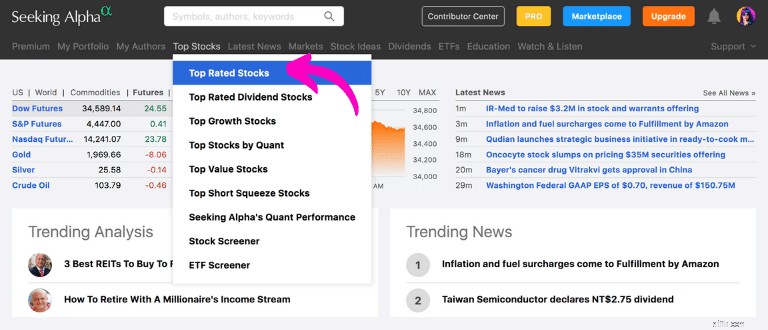
From there, you’ll see a summary of the top rated stocks, and typically the highest Quant Rating is 4.99:
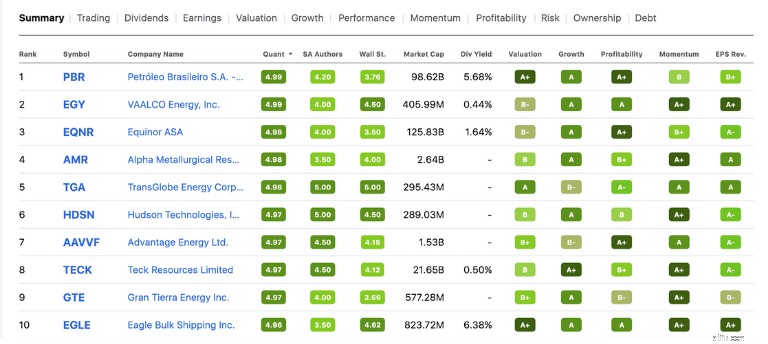
Remember what was said in the previous Quant Ratings section:
Stocks given a Quant Rating of 4.5 or higher have typically outperformed the S&P 500 by up to 4x!
And it’s true that across the board PBR, also known as Petrobas, (in this case the top Quant rated stock) is considered a “Buy” to “Strong Buy” across the board:
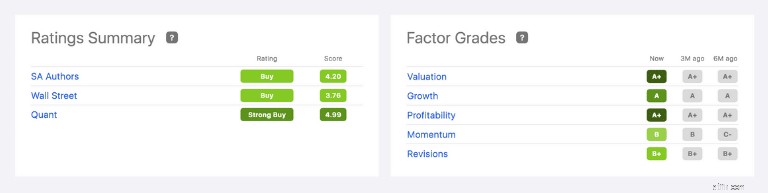
This stock screener is a feature that is currently available to Premium users.
Another neat trick with the Stock Screener?
You can customize your own stocks by using up to 100 different filters!
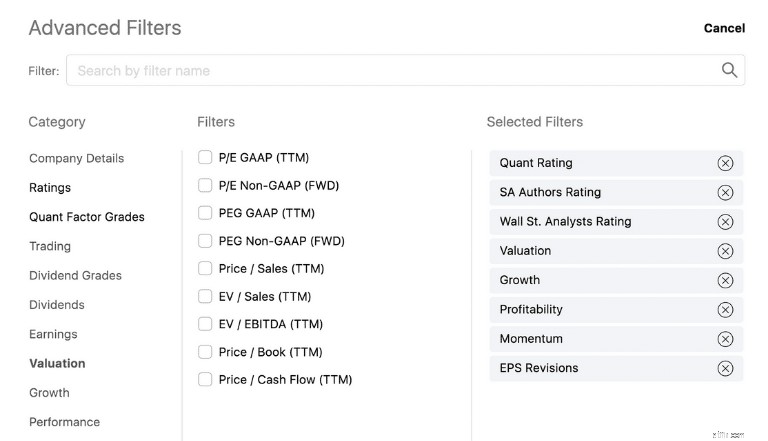
Above is just an example of the many different filter applications you can use to customize your stock screener.
Based on historical performance, stocks ranked as 1.5 or lower drastically underperformed the S&P 500.
If you want to follow what sell-side analysts have to say in terms of buying, holding, or selling a stock, then check out the Wall Street Ratings.
Instead, Seeking Alpha collects data from the Wall Street analysts to determine whether a stock is rated as:
The reason why Wall Street Ratings can be helpful for people like you and me is that these rankings should (in theory) be objective and neutral.
To review the Wall Street Ratings of a certain company, just type in the company name or ticker symbol in the “Search” bar on the top, and then look at the information on the right of the screen.
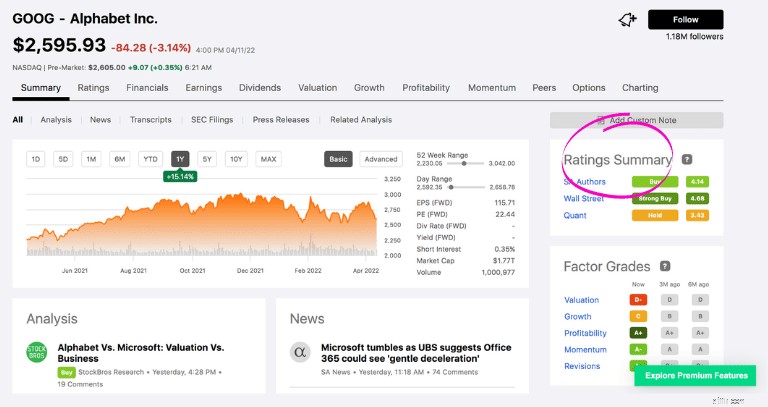
When you look at the right-hand side, you’ll see the “Ratings Summary” outline, with 3 titles:
To learn more about the Wall Street rating, click on the “Wall Street” blue hyperlink.
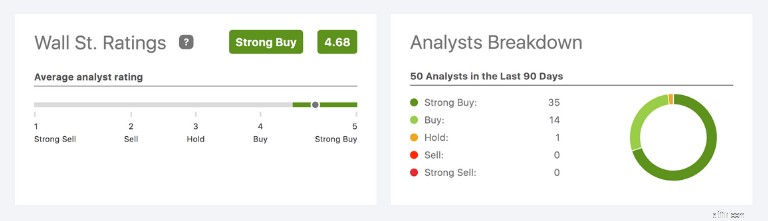
Among other factors, you’ll see the Wall Street average analyst rating and the Analyst Breakdown for each rating.
In Google’s case, 49 out of 50 Wall Street analysts recommended to Buy or Strongly Buy the stock (that’s 98% of analysts!).
Furthermore, you can also review the Wall Street Ratings’ track record for the past few years:
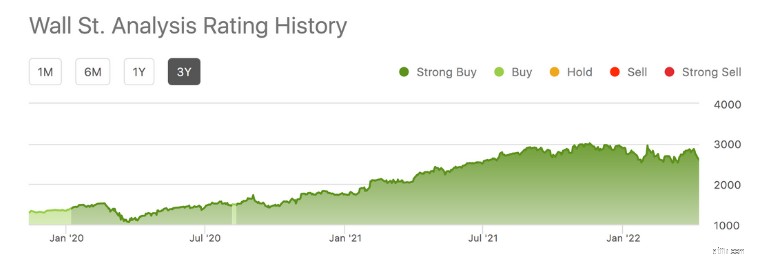
Based on this graph, Wall Street analysts have recommended to Buy or Strongly Buy Google over the past 3 years.
Lastly, you can also see how the Wall Street analysts’ opinions have changed over time with the Recommendations Chart (found at the bottom of the page):
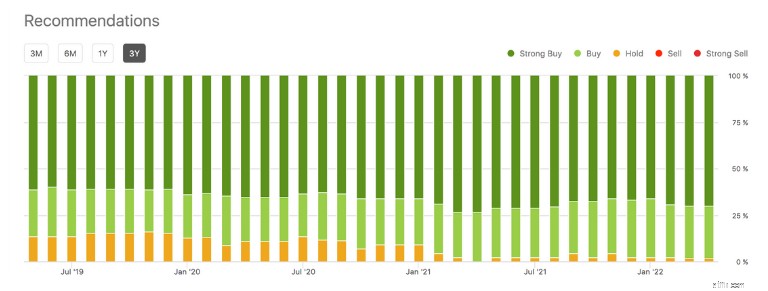
It appears that in 2019 and early 2020 more analysts recommended to hold Google, while starting in 2021, virtually all analysts recommended to buy Google.
Since I’m a very visual person, one of my favorite features on Seeking Alpha is the data visualization of the charts.
In fact, Seeking Alpha has a specific tab named “Charting” that you can access to view the data in an aesthetically pleasing manner:

Once you click on the “Charting” tab, you can even customize the data you want to view.
For example, you can compare one stock’s performance (in the case, Gamestop) to another stock or benchmark like the S&P 500:
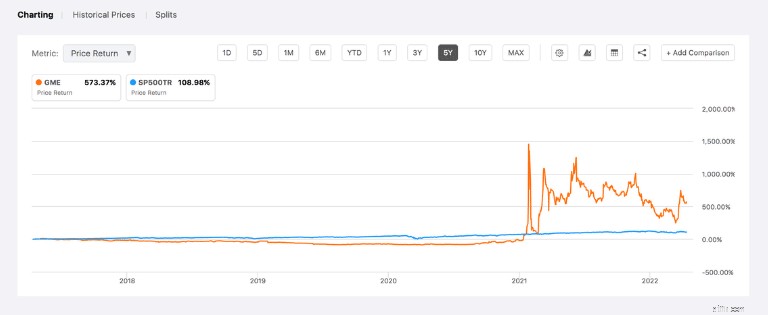
In this custom comparison, you can see that the S&P 500 has typically outperformed Gamestop until early 2021.
If you want to add additional stocks or funds to compare, you can do so, as well:
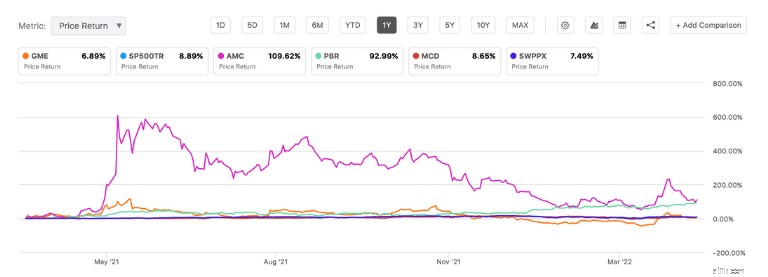
Another neat way to customize your data is changing the format of the data presentation – you can select:

If you’re happy with the data visualization chart you created, you can also copy to clipboard, download, or copy the link to your chart for future reference.
If you’re a Seeking Alpha member, you have exclusive access to earnings calls transcripts.
In most cases, you can expect to have an earnings call at the end of the first 3 quarters.
At the end of the 4th quarter, you’ll receive both an annual report as well as a quarterly report.
If you’re busy at the time of the actual earnings call, you can always count on Seeking Alpha to have a transcript available – both audio and written versions.
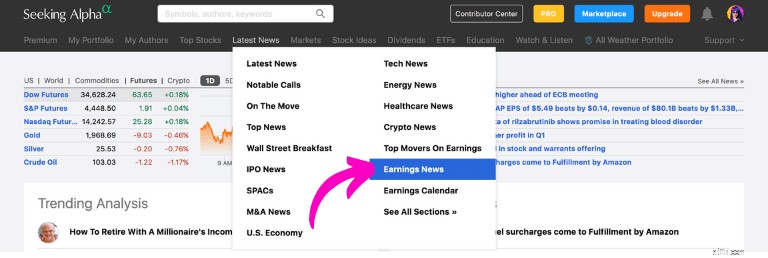
You can access the earnings reports of any publicly-traded company by hovering over “Latest News” and then clicking on the “Earnings News” button.
You can also access a schedule of the upcoming earnings calls by clicking on the “Earnings Calendar.”
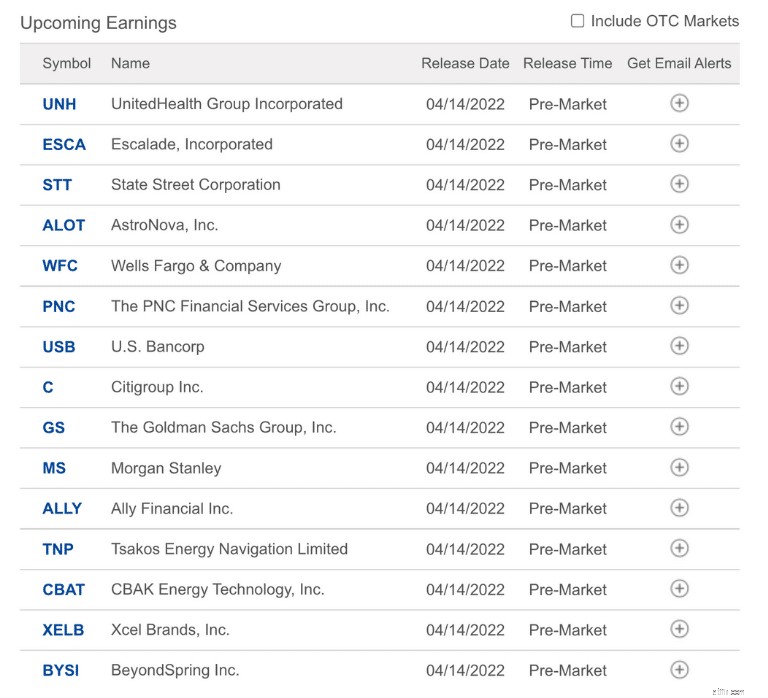
Once in the Upcoming Earnings tab, you can select which company you want to listen to and you can even sign-up for custom email alerts by clicking on the “+” sign.
If you’re looking up one of your favorite companies, let’s call it Amazon, then you just have to click on the “Earnings” tab for that stock:

From there, you can click on the “Transcripts” tab and look at all previous transcripts:
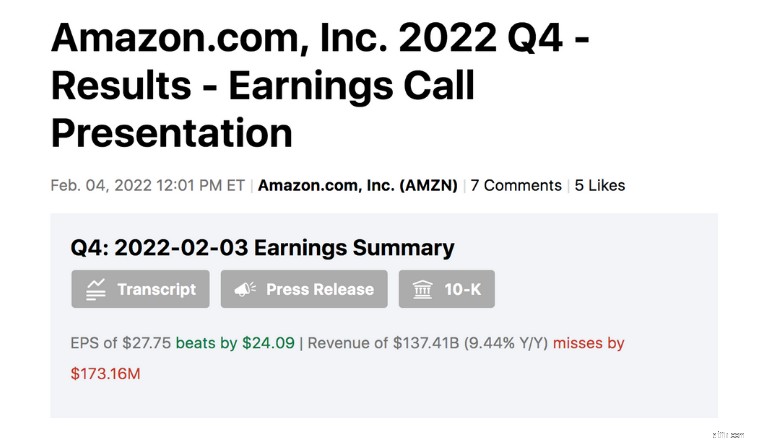
Depending on the company you review, you can also access a PDF file with slides that highlight the company’s key points.
With the Premium (and of course Pro) memberships, you also have unlimited access to exclusive articles written by industry professionals.
Since there is so much information, you can filter out the articles in several different ways.
First, you can simply access your home page and review the “Trending Analysis” of the day or the “Trending News” of the day.
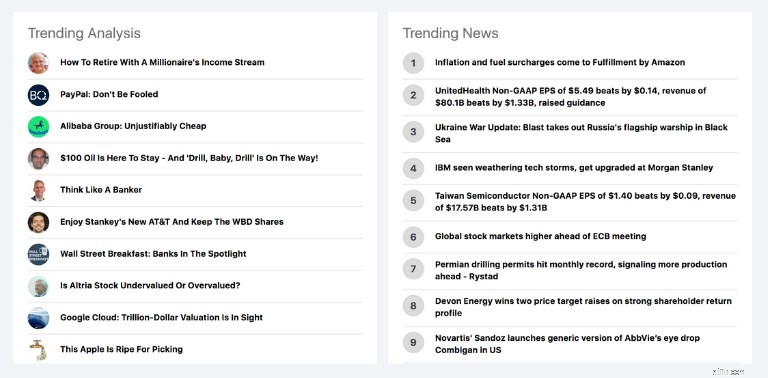
If you want to review articles written by various authors about just 1 particular stock or fund, then just type in the stock name or ticker symbol into the Search Bar.
From there, click on “Summary” and then on “Analysis” so you can see the various articles offered by authors on that stock.
Here’s an example of articles written about the Tesla stock:
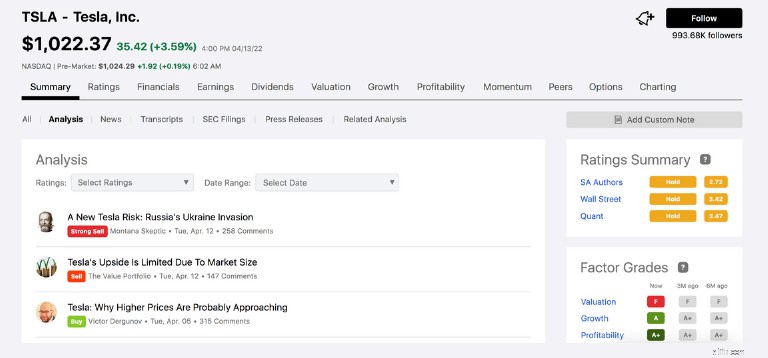
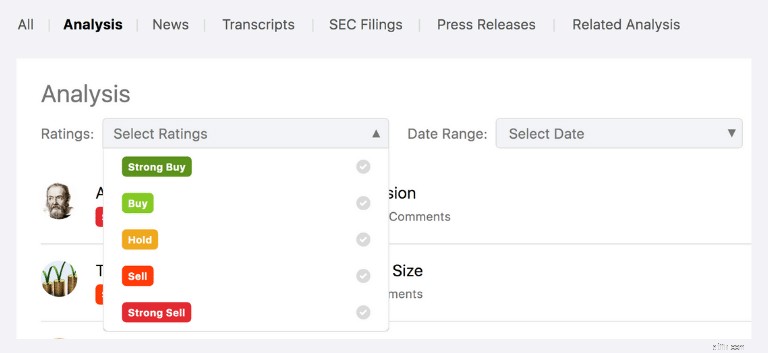
If you want to read articles from authors who advocate buying, selling, or holding, you can customize your ratings by clicking on the “Select Ratings” drop down box.
While most articles do focus on US-based public companies, there are some articles that also focus on alternative investments as well as international companies.
As a Premium Seeking Alpha user, I’m a very big fan of creating your own portfolio in Seeking Alpha.
If you’re dedicated to kickstarting your kids’ financial future, then you may also want to check out the Greenlight Debit Card , which can do wonders.
You can set up your own mock portfolio in Seeking Alpha by hovering over “My Portfolio” and then clicking on “All Portfolios.”
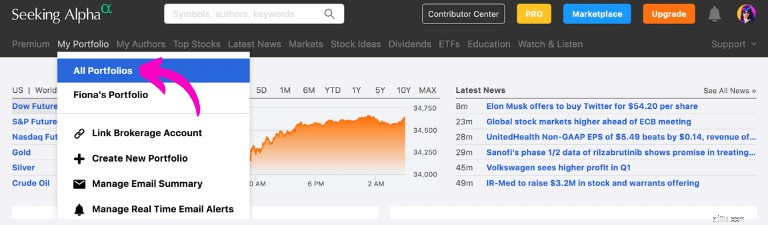
From there, you can click the button titled “+ New Portfolio.”

This will allow you to add a new, mock portfolio while using the Seeking Alpha platform.
You can give that portfolio a title and then you can either link your outside brokerage account to this portfolio or add your own stocks to the portfolio.
For the purpose of this section, we’re going to click on “Create Portfolio.”
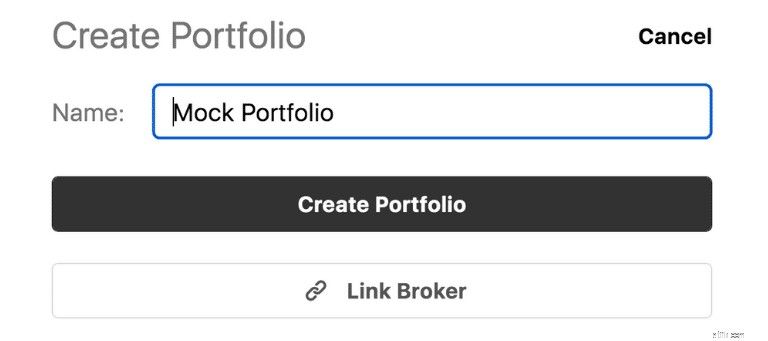
Once you’ve created your portfolio, you can start adding ticker symbols to complete your portfolio.
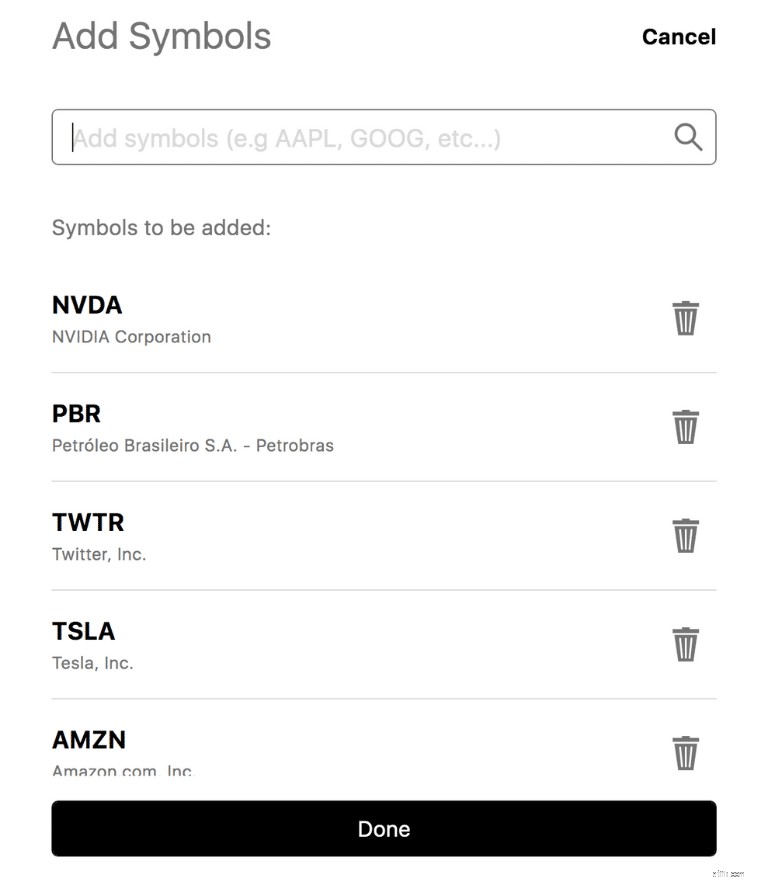
Once you’re happy with your portfolio construction, you can click “Done.”
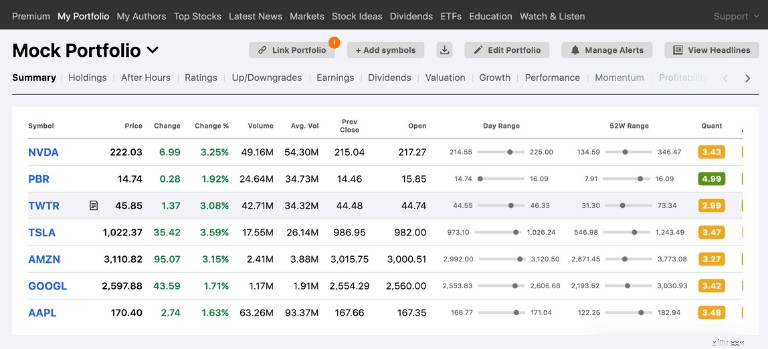
Seeking Alpha does a fantastic job breaking down each stock in your mock portfolio by using multiple different factors.
You can even compare the Quant, SA Authors, and Wall Street ratings to each other:
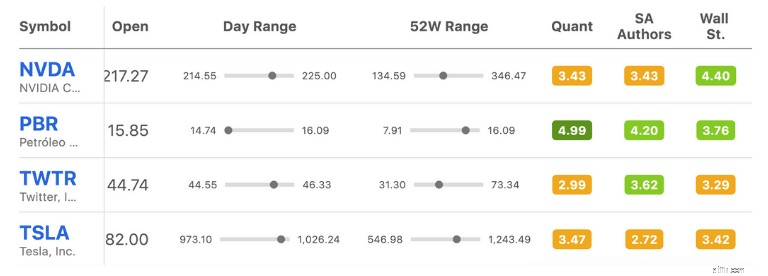
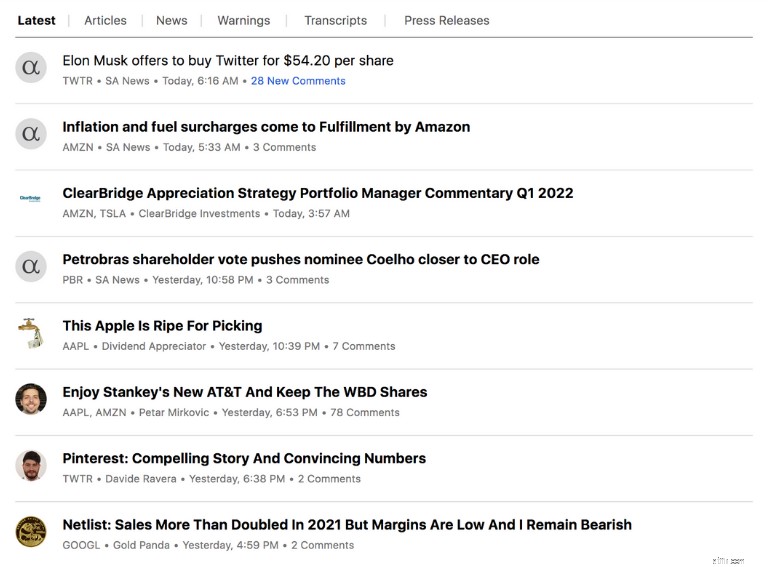
If you click on the “View Headlines” button in your portfolio, you’ll see an assortment of articles written just for your specific stocks in your portfolio:
Finally, one of the other notable features of your Mock Portfolio is the custom alert and notification button.
When you click on “Manage Alerts” you can customize your alerts based on:
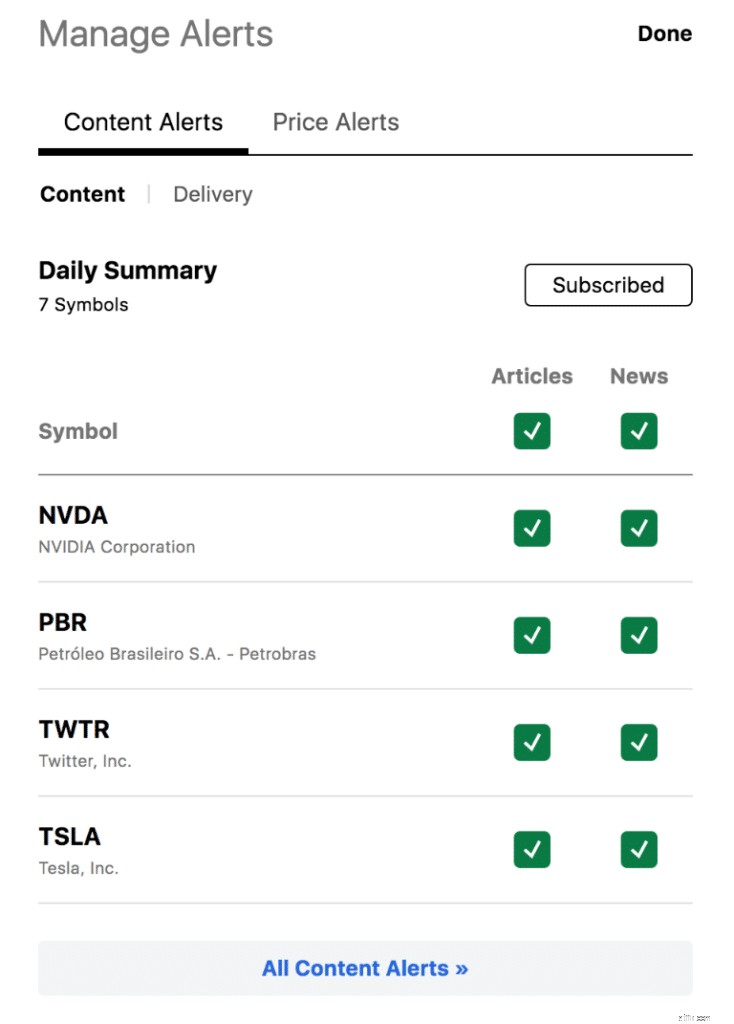
So, if there is an update on a stock like Twitter for example, you’ll receive real-life notifications to your email or phone – depending on the delivery method that you select.
You can also manage your price alerts, which I will review in a separate section here.
If you’ve already created your mock portfolio through Seeking Alpha (or even if you’ve already connected your outside brokerage account with Seeking Alpha), you can set custom price alerts.
For example, if you own shares of Twitter and the current price Quant Rating is 2.99, which is nearing a sell territory, then you may want to filter for other stocks that might be deemed a “Strong Buy.”
Here’s how (this is assuming you’ve already set up your own portfolio in Seeking Alpha. If not, then please reference the previous feature):
First, access your portfolio and click on “Manage Alerts.”
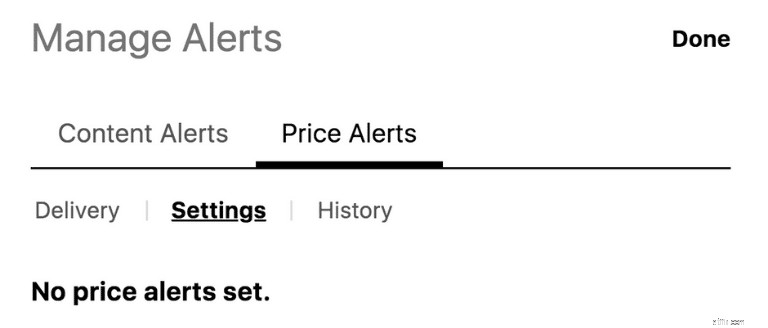
Then, click on “Price Alerts” and then on “Settings.”
From there, you’ll want to click on “All Price Alerts,” which you’ll find at the bottom of the dialogue box.
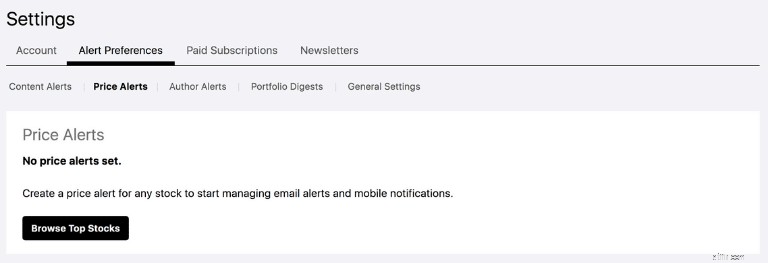
From there, click on the “Browse Top Stocks” button.
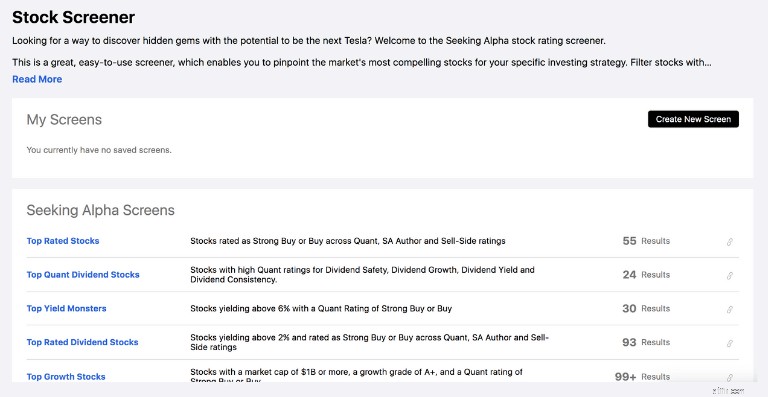
You can either continue using the Seeking Alpha Screens (and there are many) or you can create your own, custom screen.
If you create your own custom screen, you’ll be brought to a window like the one below:
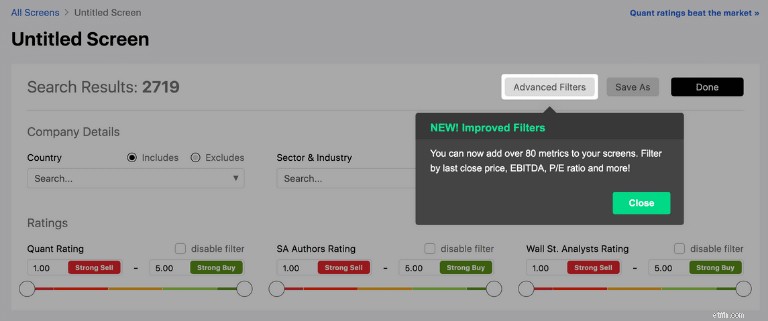
You can customize your stock screener by adding up to 80 different filters.
For example, if you want to screen for all stocks that are assigned a 4.00 out of 5.00 rating for the Quant, SA Authors, and Wall St. Analysts, this is the place to do so.
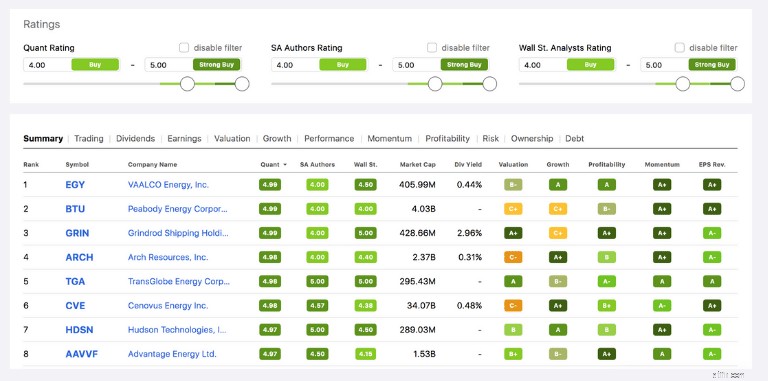
Take some time to experiment with the screening tool, because there is just so much information.
However, if you’re ever wondering why or how to filter for the best stocks for your portfolio (or your child’s portfolio), this is probably the tool you’ll want to use.
If you’re an investor who really enjoys digging deep into the financials for each company before trading its stock, you’ll be happy to know that the Premium tier also comes with downloadable financial statements .
In fact, you can access up to 10 years worth of financial statements to download, review, and analyze.
Just search your favorite company and click on the “Financials” tab.
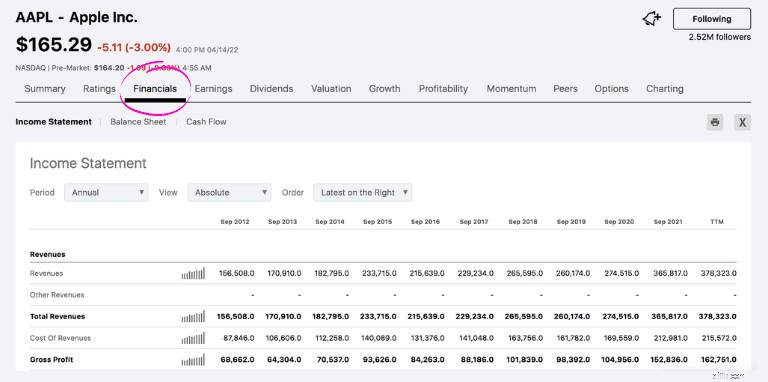
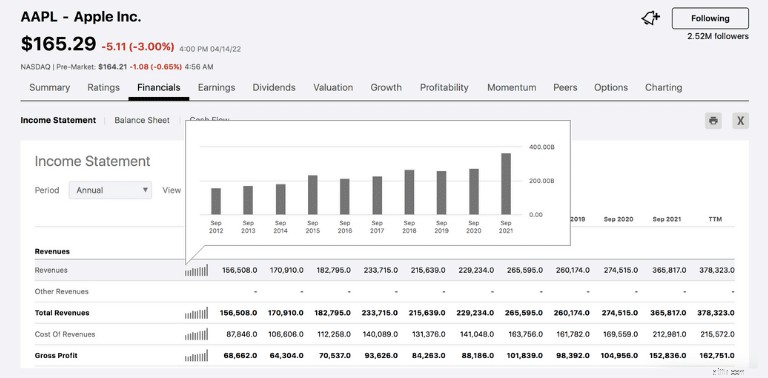
From there, you can either review the numbers or for a more visual approach, just hover over the line graph for each data set:
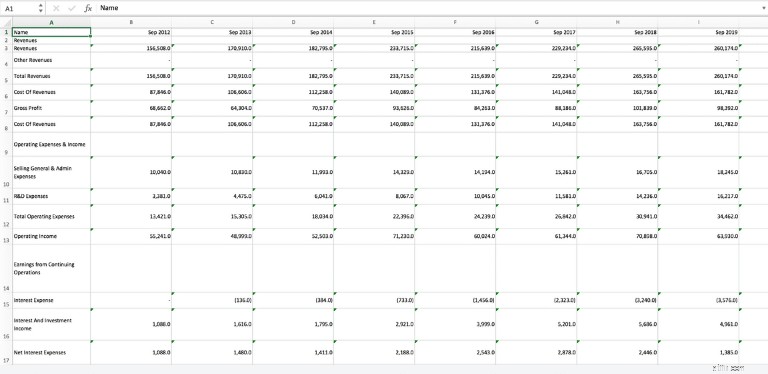
If you want to review the numbers in even more depth, you can click on the print icon or the “X” icon at the top, right of your screen to either print to PDF or download via Excel.
So depending on how in-depth you want to go, Seeking Alpha really gives you a lot of options to analyze your stocks.
Ever wonder how your current stocks compare to other stocks in the marketplace?
Take a look at the Stock Performance Comparison Tool – which is one of my favorite tools.
Just search your favorite stock and then click on the “Charting” tab.
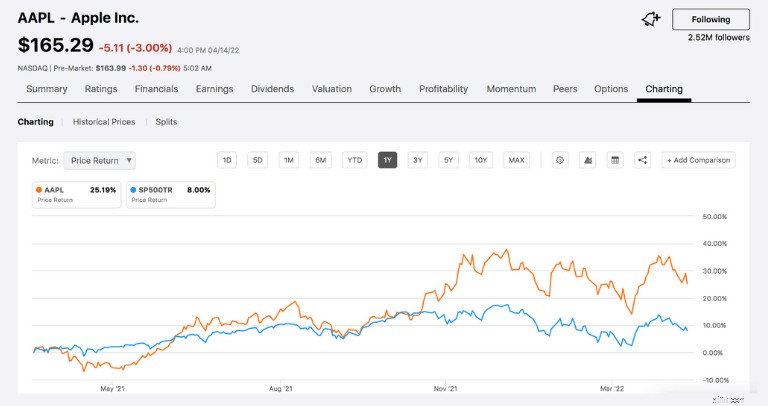
The default comparison is your stock (in this case, Apple) and the S&P 500.
However, if you want to know how apple is doing compared to another individual stock in the tech or a similar sector (like Tesla), then just click on the “+ Add Comparison” button and add your favorite stock:
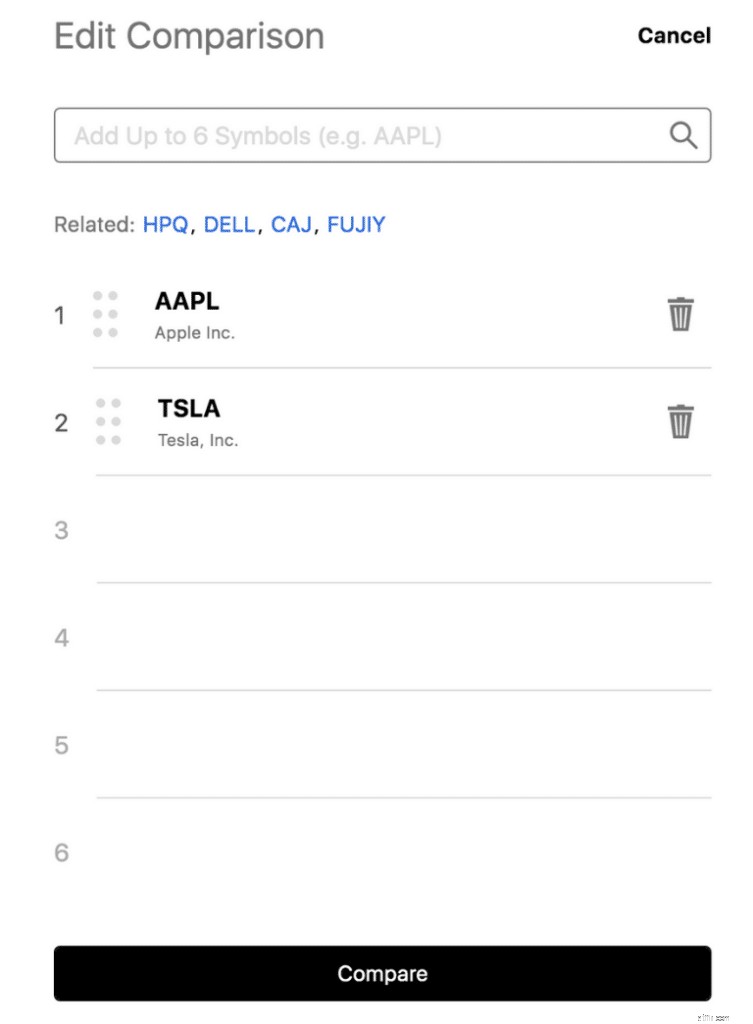
Now take a look at the comparison of Apple stock versus Tesla stock over the past 3 years:
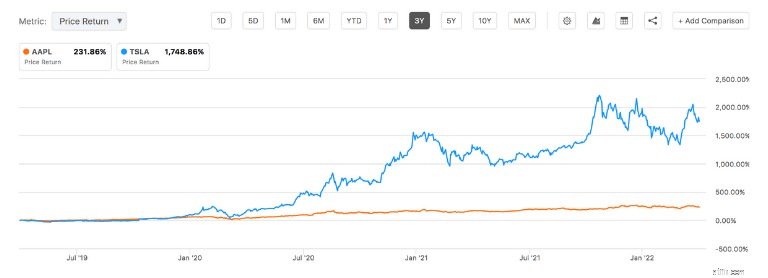
While this stock performance comparison chart shouldn’t be the only tool you should use to determine whether a stock is worth a purchase, it can certainly be a helpful guide.
Lastly – but certainly not least – another cool feature with the Premium Tier is that you can link your outside investment accounts to your Seeking Alpha account.
Remember that you’ll receive access to Seeking Alpha’s quant comparison tool, the Wall St. Analyst ratings, and the SA Author rankings – along with customizing real-life alerts for each of the stocks you hold.
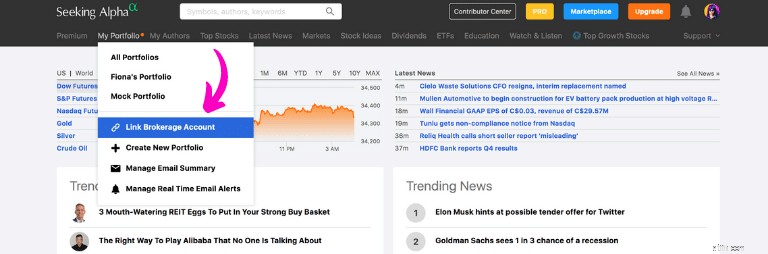
To start linking your outside accounts, just navigate to your main menu, hover over “My Portfolio” and then click on “Link Brokerage Account.”
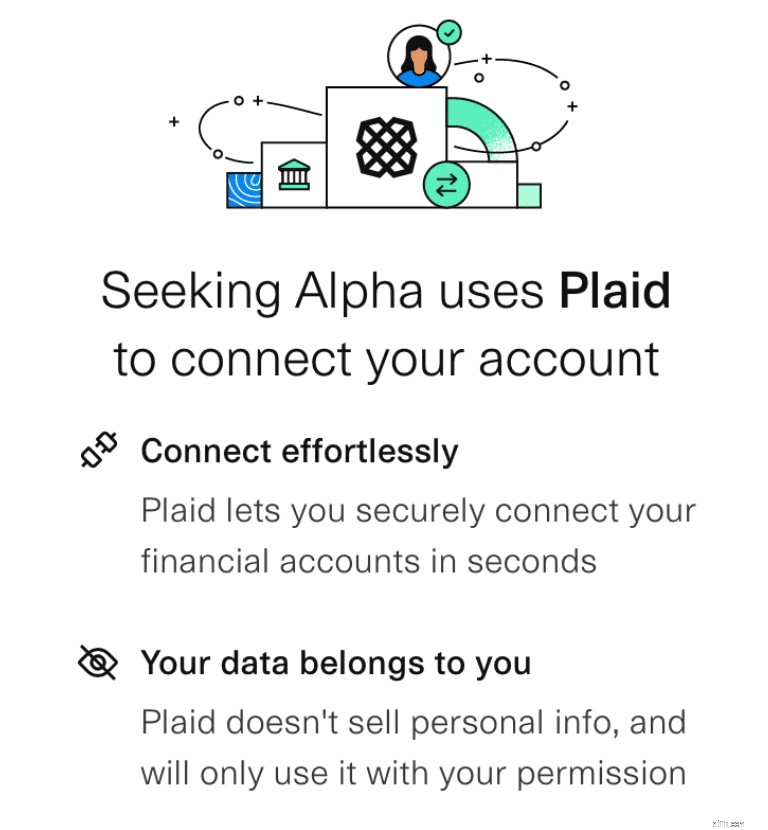
Any outside brokerage accounts that you link will be connected using the secured encryption software, known as Plaid.
You can select a number of different brokers, such as:
Even if you don’t see your brokerage firm immediately, you can either search for your brokerage firm or sometimes even input the information manually.
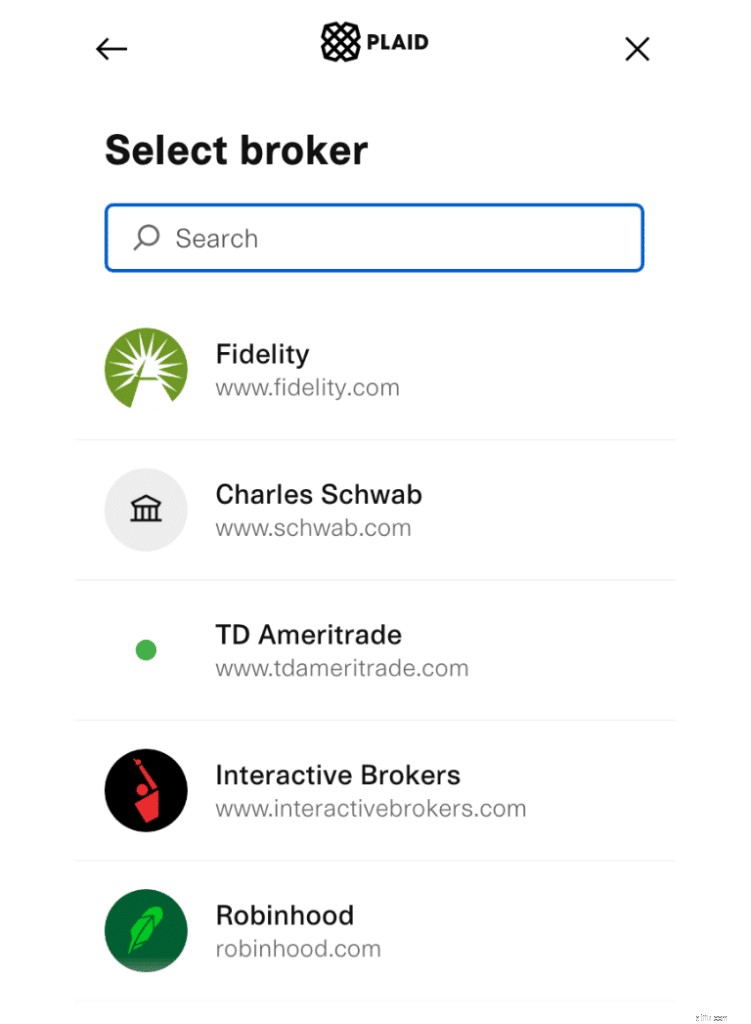
Once you’ve established a link to your brokerage account, you can do the following:
Keep in mind that Seeking Alpha is an informational platform only – you cannot place investment trades on Seeking Alpha.
So to buy or sell stocks in your linked brokerage account, you’ll actually have to sign in to your own investment account.
Recommended Reading:Best Investment Apps
Seeking Alpha Premium could be right for you if you:
Being a Premium Plan member myself, my favorite part is that you can use the Premium tier for as much or as little research as you want.
For example, if you’re thinking about adding Build-A-Bear Workshop, Inc. (BBW) to your portfolio, and you want some additional advice from industry experts.
In this case, just check out the BBW stock rankings in the Ratings Summary section.
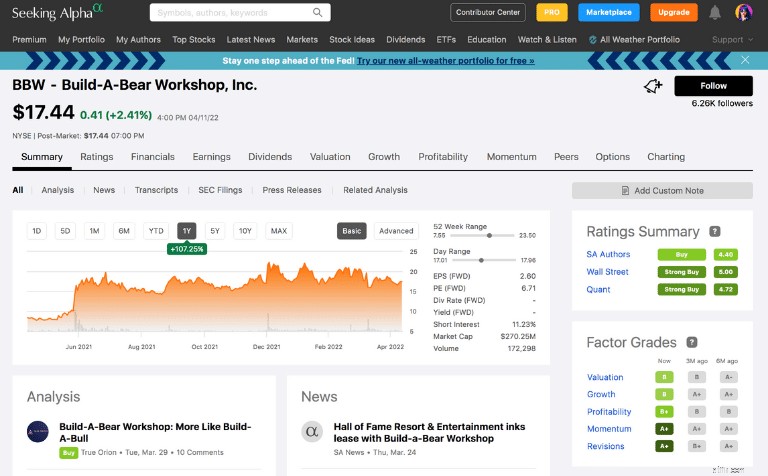
You’ll see that on 3 different instances, the BBW stock is considered a Buy to a Strong Buy opportunity:
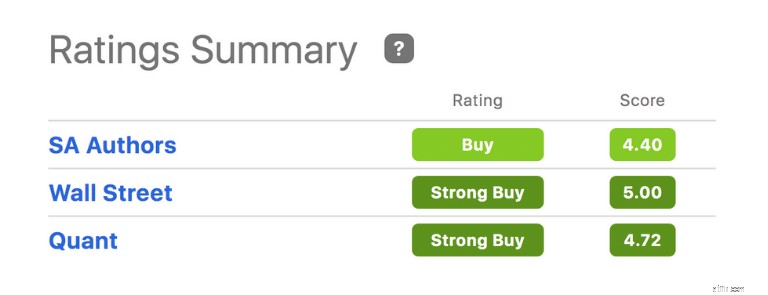
Now, if that’s all the reassurance you were looking for, you can move on and not look back.
However, if you want to drill into more depth with the Build-A-Bear Workshop, Inc. stock, Seeking Alpha lets you do as much fundamental analysis as you want.

The Bottom Line:
The Premium Plan gives intermediate investors the best of both worlds:Reassurance on which stocks to buy, hold, or sell while also going into as much analytical depth as possible.
Just like the Premium Plan, you can also start a 14-day free trial period with the Seeking Alpha Pro Plan .
If you enjoyed the Pro Plan trial period, then you can pay for the Pro Plan in 2 ways:
Monthly Plan
$299.99/month
Annual Plan
$2,400 (or $199.99/month, as advertised)
It appears that the default case for Seeking Alpha is charging the full year’s worth of premiums upfront (so $2,400 in this case).
One of the best benefits to the Pro Plan is that you receive VIP access and Editorial Concierge, customized to your needs.
Keep reading to find out more about the key features of the Pro Plan.
In this section, I’ll explain in detail some of the top Pro Plan features and how you can benefit from each (keep in mind that the Pro Plan already comes with the Premium Plan features).
Below is an overview of the additional Seeking Alpha Pro Plan features:
With the Seeking Alpha Pro Plan, your entire user experience will be ad-free.
Remember that the Limited Access version does come with ads and the Premium version offers an ad-lite user experience.
The Seeking Alpha Pro platform gives you the chance to be as specific as possible when filtering your investments.
You can filter your investments by:
If you know what you’re doing and if you know what you’re looking for, then this investment screener can be used to your advantage.
If you want the bells, the whistles, and the exclusive VIP treatment, then you should consider the Pro Plan.
The editorial team works directly with Pro level subscribers to filter out and pinpoint ideas that fit to your investing needs, style, and preferences.
If you want daily short summaries of the top 1% of the Seeking Alpha content, then your Seeking Alpha Pro level subscription will give you that VIP treatment.
As a Pro member, you’ll have Seeking Alpha’s industry experts send you a weekly list of their hand-picked top investment ideas from Seeking Alpha contributors.
Seeking Alpha Pro could be right for you if you:
Another neat feature is that you could also contribute to the Seeking Alpha community by writing an article with your research and opinion.
The Bottom Line:
The Pro Plan gives advanced investors and industry professionals an in-depth and resourceful experience when researching and analyzing stocks, funds, and ETFs.
I’ve personally reached out to Seeking Alpha’s customer service on 3 different occasions to evaluate their:
…And I must say that Seeking Alpha passed my test with flying colors.
Below is my evaluation:
Knowledge
⭐️⭐️⭐️⭐️⭐️
Friendliness
⭐️⭐️⭐️⭐️⭐️
Experience
⭐️⭐️⭐️⭐️⭐️
I’m drawing from my own personal experience from speaking with 3 different Seeking Alpha personal representatives.
The good news is that you can contact Seeking Alpha in 4 main ways:
E-post
contactus@seekingalpha.com
Social Media
– YouTube
Navigation Bar
Support Button
Phone Call
347-509-6837
Phone Support Center Hours
Monday to Friday 8am to 4pm EST (holiday hours may apply)
It’s reassuring for me to see the different ways you can contact Seeking Alpha.
While Seeking Alpha is not accredited with the BBB, I was still shocked to see the “F” rating on the BBB website:
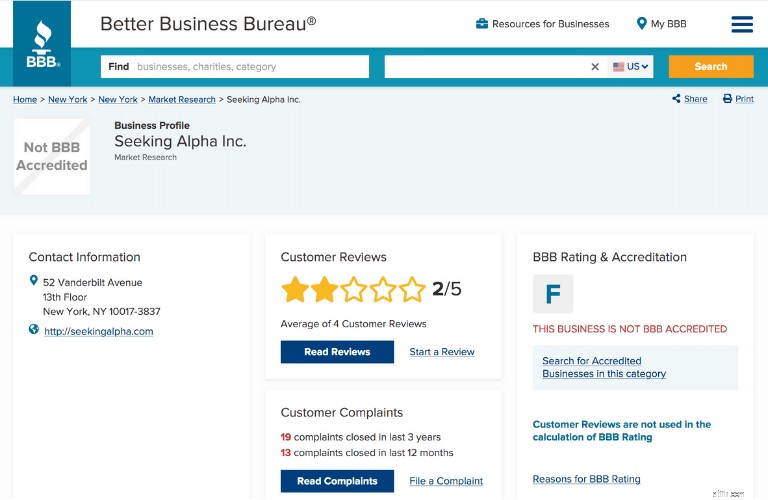
I even double-checked to see if I had the right Seeking Alpha company pulled up on my screen – and I did.
The common complaints appear to only apply to subscribers looking for the “free trial” period:
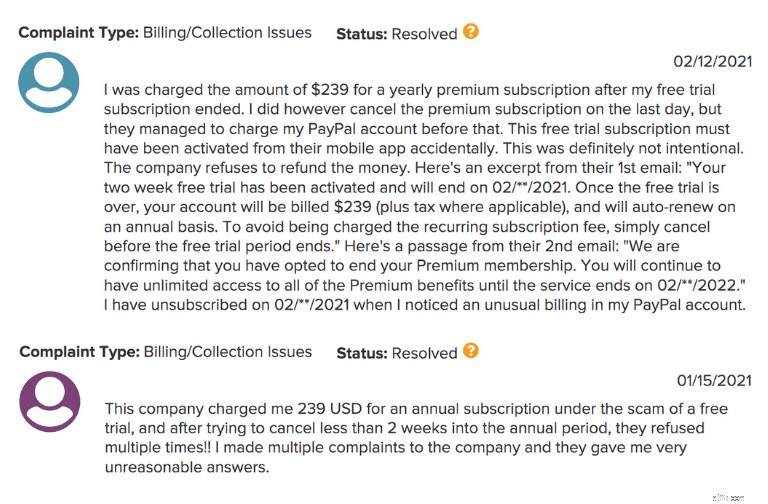
Based on these complaints (which are somewhat recent), it looks like many customers who signed up with the free trial period were charged after the period ended.
Based on this information, if I were signing up to the free trial period, I would probably triple check to read all of the fine print and possibly even cancel before the trial period is over (assuming you’re not happy with the platform).
Now that you have an idea of what people are unhappy about, let’s take a closer look at the ratings on TrustPilot, which is another customer review website.
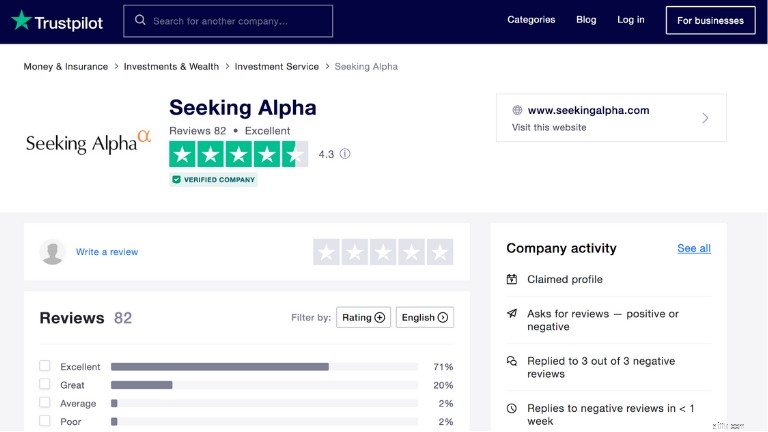
Now, this Trust Pilot customer review is more in line with what I was expecting to see.
On TrustPilot, a solid 93% of respondents rated Seeking Alpha average to excellent.
Some reviews are below:
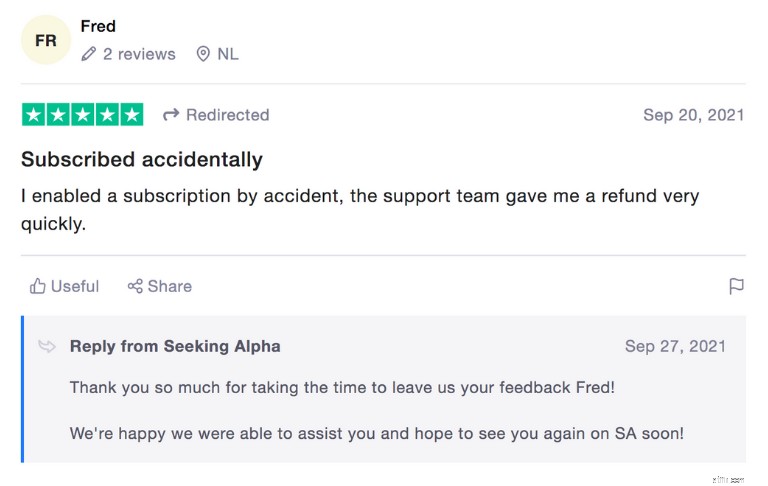
This review virtually contradicts the reviews from the BBB, which said Seeking Alpha did not offer a refund.
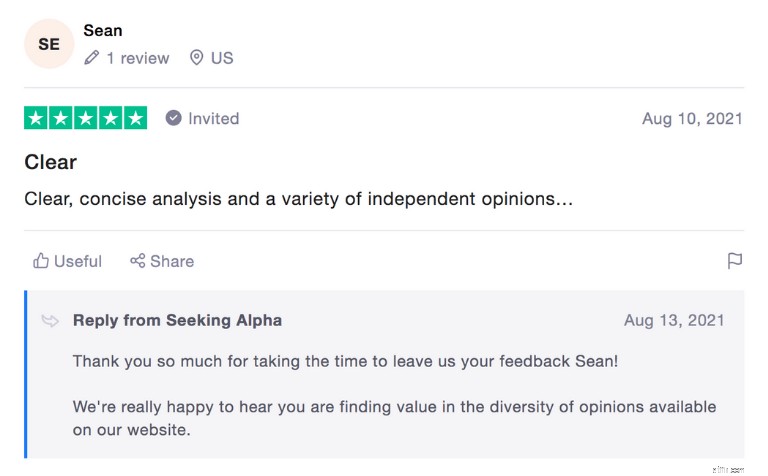
Above is another positive review about the accuracy and impartiality (no bias) of the authors that provide information on Seeking Alpha.
Of the 2 negative reviews that were posted from the 82 total reviews, the complaints were the following:
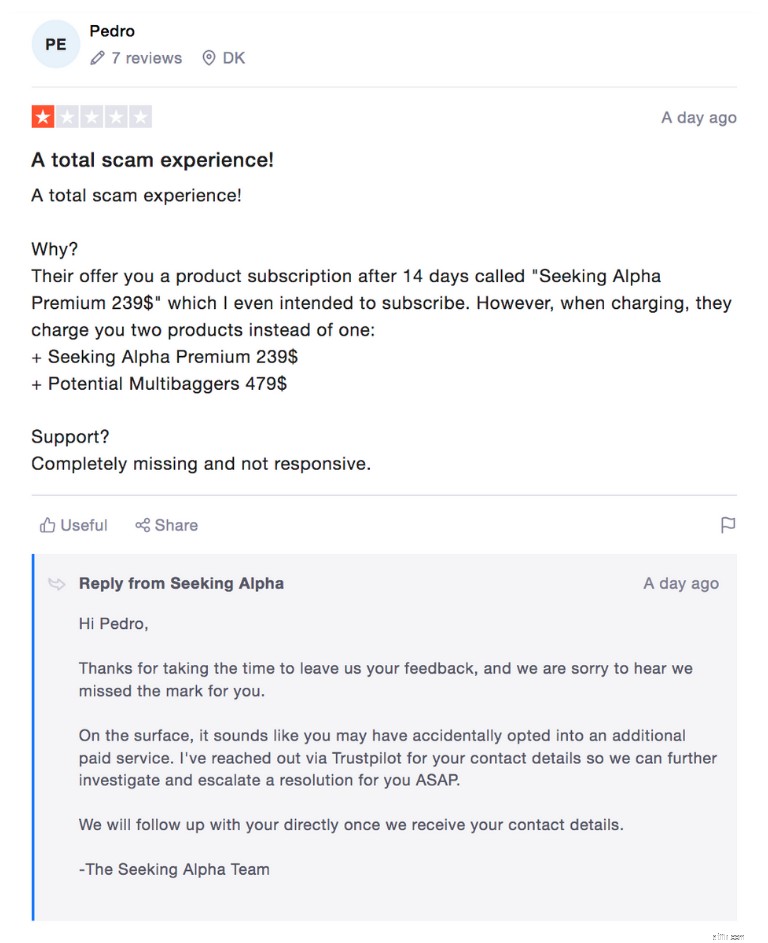
Take a look at the response time of when the negative review was posted (1 day ago) versus the reply from Seeking Alpha (also 1 day ago).
I thought that was impressive.
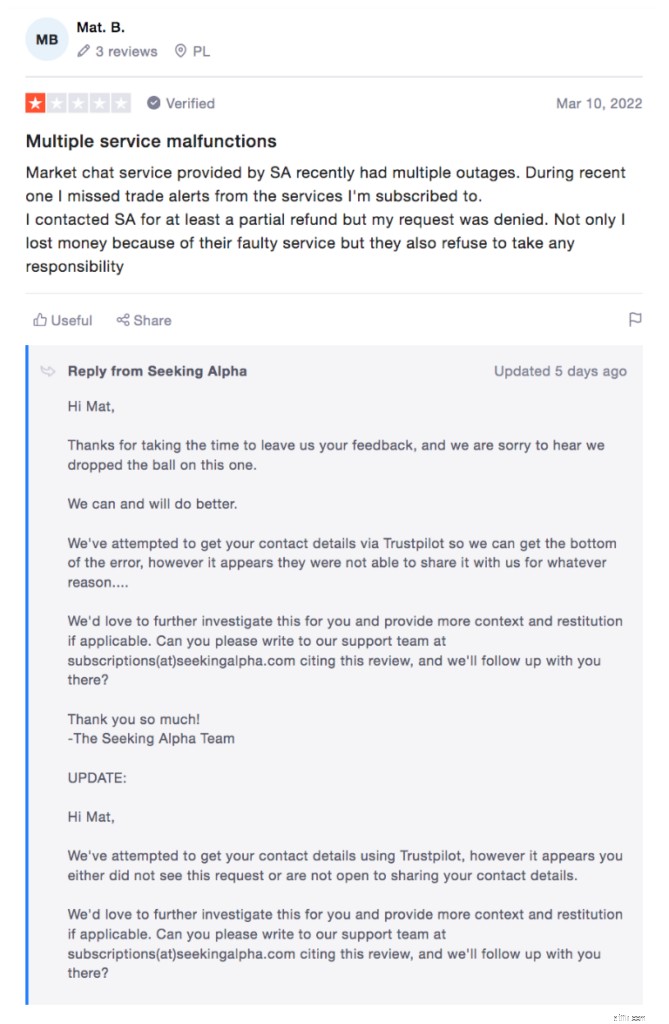
As you can see, there will always be good and bad reviews, and you’ll have to take the reviews with a grain of salt (seriously).
Personally, I like checking back into the customer service review platforms every few months, just to read updates.
The Bottom Line:
Most of the “Bad” Seeking Alpha reviews involve the free subscription service. According to the complaints, immediately after the free trial period ends, the consumer credit card will be charged the annual amount for a paid subscription (likely the Premium subscription).
Now it might sound daunting that Seeking Alpha offers works from 7,000 active monthly authors.
You might even be concerned about the quality of the information if there are so many contributors.
Their team has a pretty quick article turnaround time as well, which typically ranges between 1 hour to a few business days.
Do you have industry expertise and want to contribute?
Below are 9 of the most important requirements to pass the rigorous Seeking Alpha editorial review process:
Market-Oriented
Write about stocks, sectors, ETFs, or other actionable themes for US-based investors
High-Quality
Articles must be convincing, well-presented, and actionable
Fundamental Analysis
Articles must address factors such as a company’s competitors, products, management, corporate strategy, etc.
Originality
Always bring a new perspective to a topic
Compelling Title
Your title shouldn’t overpromise and underdeliver
Market Cap
Articles mentioning stocks trading at less than $1 or companies with market caps less than $100 million will receive extra scrutiny
Clean
You must proofread your article before submission
No Promotional Content
No promotional content in articles
Human Factor
Editors work closely with contributors and maintain a constructive dialogue
As you can see, there are a lot of requirements that go into the making and the publication of a Seeking Alpha article, so chances are that you’ll get the high quality you want.
And with each month, over 10,000 articles are published on Seeking Alpha!
Another neat thing is that you can view a contributor’s past track record of stock predictions.
Another trick to finding information from top ranked authors is just simply clicking on the “Top Authors” button.
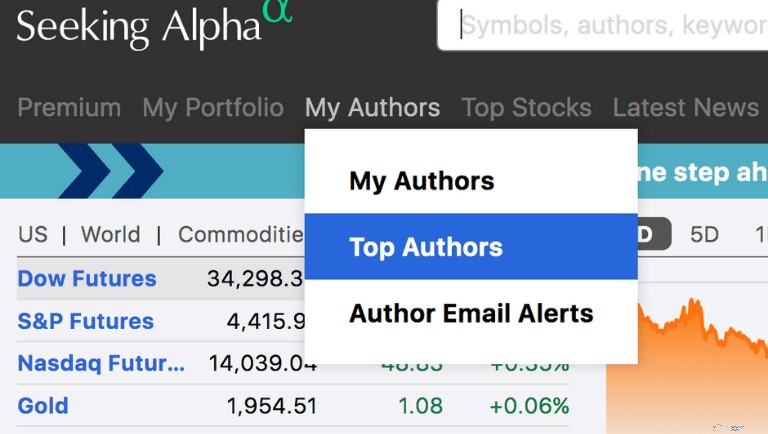
Once in the Top Authors section, you’ll receive a long list of author suggestions, based on their specialty (such as value investing, growth investing, oil &gas investing, etc.).
Another reason why I’m a big fan of Seeking Alpha is because of the abundance of educational resources this platform offers its users:
Investment Videos
Access top investment news videos by clicking on the tab “Watch &Listen” and then clicking on “Videos”
Investment Podcasts
Learn more about the latest investment news by accessing 8 Seeking Alpha podcasts. Click on “Watch &Listen” and then on “Podcasts”
Financial Planning Education
Seeking Alpha knows that investing is just a part of the financial planning process. When you click on the “Education” tab, you’ll gain access to a variety of different financial planning topics, ranging from cryptocurrency to 401(k) management
Seeking Alpha Knowledge Base
Type any question into the search box and you’ll probably find an answer. The Knowledge Base can be accessed by clicking on the “Support” icon and then “Knowledge Base”
Feedback Forum
If you ever have trouble with the Seeking Alpha desktop website or the mobile app, this is the place to share your concerns, feedback, and interact with other users. Access the forum by clicking on the “Support” icon and then “Feedback Forum”
As you can see, Seeking Alpha does not keep you in the dark – when it comes to investing or financial planning-related matters.
One of my favorite learning sections on Seeking Alpha is the “Education” section, where Seeking Alpha users can learn about more than just investing.
Under the education tab, you access articles about other topics that may not be covered in-depth by the Seeking Alpha Authors.
Some of these topics include:
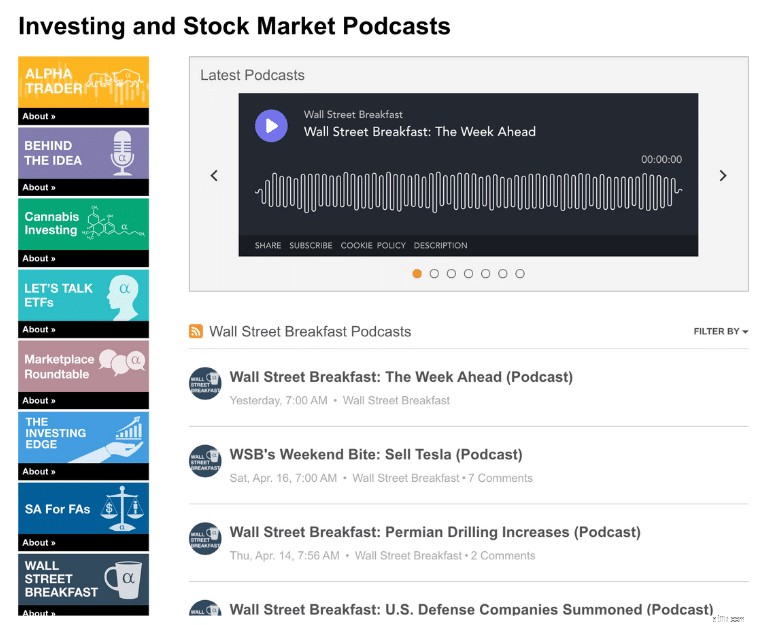
I’m also a fan of the “Watch &Listen” section, which offers Seeking Alpha readers access to investment podcasts and videos.
If I’m ever stuck in traffic, I listen to one of the podcasts (I like the Wall Street Breakfast podcast).
The good news is that Seeking Alpha offers so much variety from which to choose – you’ll never be left without ideas.
Ready to open an account with Seeking Alpha?
Believe it or not, it’s actually a very fast and simple process.
First, head to the Seeking Alpha website and click “Subscribe.”
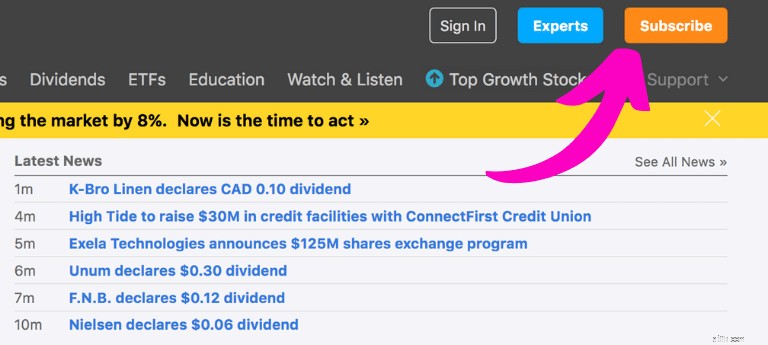
After you click the subscribe button, you can choose to either start a free trial or register immediately with one of the 3 plans (Limited Access, Premium, or Pro).
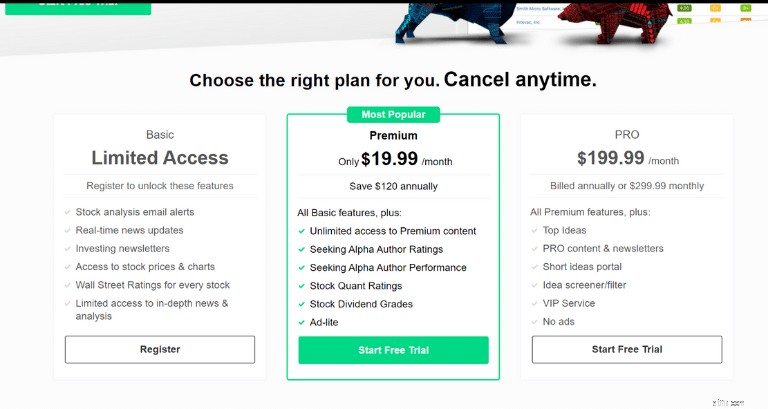
Now, if you’re ready to register and pay for your subscription, then select your plan preference.
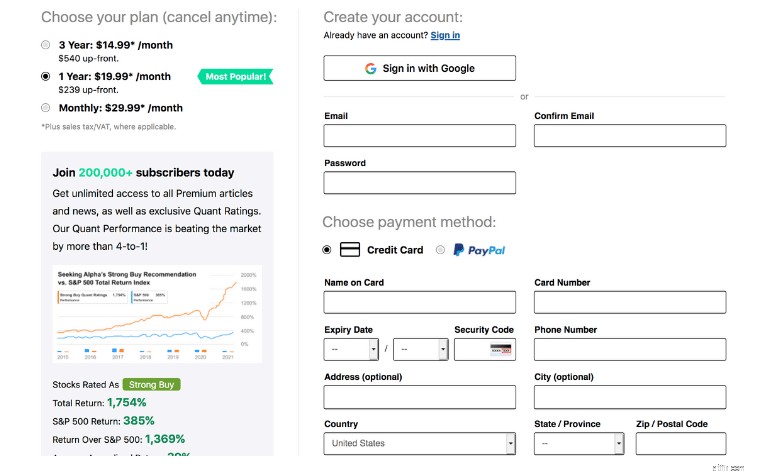
Payment methods are either via credit card or PayPal.
In my opinion, if you’re an investor who really wants to understand more about your investment holdings, then Seeking Alpha is probably a great platform for you.
Yes, Seeking Alpha is worth the cost if you do your own investment research and want to interact with experienced investors. For $19.99 per month, you get access to exclusive content from over 7,000 experienced investment authors, custom stock performance charts, and portfolio monitoring tools.
If you sign up to the Premium Platform, you can access the Seeking Alpha Quant Ratings, which have outperformed the market since 2010.
The Quant Ratings marked as “Very Bullish” for stocks were up 1,754% versus the market’s 385% gain.
On the other hand, the stocks that were rated as “Very Bearish” by Seeking Alpha really did underperform, being up by only 156% versus the market’s overall 385%.
While I’m not a fan of day trading and stock picking, if I am looking to buy or sell a stock or fund in my portfolio, Seeing Alpha would be my first stop before hitting that “trade” button.
Seeking Alpha might not be for everyone.
If you’re an active investor and just don’t like the investment research platform, then you may want to check out platforms like the Motley Fool’s Stock Advisor.
While the cost is certainly lower for new members ($99 per year), you also don’t get access to the customization, the tools, and the crowdsourcing that Seeking Alpha uses.
You can always sign up to the free version of each platform first before committing financially.
Based on Seeking Alpha’s track record, yes, Seeking Alpha is reliable. As an example, Seeking Alpha’s “Very Bullish” stock evaluation ratings have outperformed the market since 2010, up 1,754% versus the market’s 385% gain.
Seeking Alpha’s Premium membership is absolutely worth the cost if you want to conduct your own investment research and interact with experienced investors.
You pay $19.99 per month in exchange for exclusive access to content from over 7,000 experienced investment authors, custom stock performance charts, and portfolio monitoring tools.
Yes, Seeking Alpha’s Premium membership is worth the cost if you do your own investment research and want to interact with experienced investors. For $19.99 per month, you get access to exclusive from over 7,000 experienced investment authors, custom stock performance charts, and portfolio monitoring tools.
You can still use Seeking Alpha as a free user under the Limited Access plan. However, you can unlock only 5 articles per month before being prompted to sign-up as a paying Premium member. The Premium membership costs $19.99 per month as of early 2022.
Seeking Alpha is probably one of the best tools for day traders, active investors, and even swing traders. If you want to do your own investment research and learn from industry experts, then Seeking Alpha really is a good fit.
If you aren’t a day trader or someone who enjoys researching and picking stocks for their portfolio, then Seeking Alpha is probably not for you. For example, passive investors who use mutual funds, index funds, or even ETFs probably won’t find too much value from the Seeking Alpha platform.
Seeking Alpha was founded by David Jackson in 2004. Jackson is a graduate of Oxford University (undergraduate) and The London School of Economics (graduate).
He worked as a technology research analyst at Morgan Stanley, where Jackson saw a problem (the conflict of interest stemming from investment banks publishing information about the products they sell) and developed a solution with the unbiased Seeking Alpha platform.
Seeking Alpha is likely one of the best platforms if you want to:
In my opinion, the biggest benefit you get from Seeking Alpha is the unbiased research.
For example, you won’t find research articles about funds written by the very company that sells the same fund.
There is no conflict of interest with Seeking Alpha, just pure authenticity and knowledge shared by industry experts.
You can access Seeking Alpha through 3 plans:
If you’re really planning to use Seeking Alpha as a way to evaluate your portfolio, research stocks, and learn (and interact) with investment industry experts, then you’ll probably want to sign up with the Premium Plan .
The Premium Plan offers the following features:
The list really does keep going, but you get my point.
The Premium Seeking Alpha plan offers a lot of benefits, and that’s the plan that I’m using myself right now.
The Bottom Line:
What I really like about Seeking Alpha is that this investment research platform truly is a democratized platform that shares quality ideas and insights from industry experts.
Now I’d like to hear from you:
What are your thoughts on Seeking Alpha?
Would you consider opening an account with this platform?
Let me know in the comments section below.
Hur är förtidspension ens möjlig?
Know What is an All-Weather Fund
Varför rådgivarerankningar kanske inte är allt de verkar
Fonder för nybörjare – Gamla lektioner för nya investerare
2 FTSE 250 utdelningsaktier till försäljning
Bitcoin.com Gaming planerar att bli global
IRIS lanserar AI-assistent för revisorer
Vill du ha smartare feedback från anställda? Skaffa lite spel